Last updated 2026-07-24
TL;DR
Reconstituted GHK-Cu solution requires refrigeration and lasts 7-14 days at 2-8°C or up to 28 days frozen. Lyophilized (freeze-dried) powder is stable at room temperature in sealed vials until reconstitution. Topical serums with preservatives do not require refrigeration but benefit from cool storage. Injectable formulations from compounding pharmacies arrive with specific storage instructions that must be followed.
Does reconstituted GHK-Cu need refrigeration?
Yes, once you mix lyophilized GHK-Cu with bacteriostatic water or saline, it needs refrigeration immediately. Reconstituted peptide solutions last 7-14 days at 2-8°C (36-46°F) in a standard refrigerator. No compounding pharmacy will guarantee stability beyond two weeks for a basic reconstituted preparation without preservatives. If you freeze the solution at -20°C, you can extend shelf life to 28 days, but peptides degrade slightly with each freeze-thaw cycle, so single-use aliquots are better than repeatedly thawing one large vial. Why the short window? Peptides are strings of amino acids. Water makes them vulnerable to hydrolysis (the peptide bonds break down) and microbial growth. Bacteriostatic water (0.9% benzyl alcohol) inhibits bacteria but does nothing for chemical degradation [1]. Refrigeration slows both problems but does not stop them. You'll see injectable peptide protocols from compounding pharmacies that arrive refrigerated and carry expiration dates 14-30 days out. That's the honest working range for a water-based peptide solution. If someone tells you reconstituted GHK-Cu is stable at room temperature for weeks, they're either selling a heavily preserved cosmetic product or ignoring the chemistry.
How long does lyophilized GHK-Cu last at room temperature?
Lyophilized (freeze-dried) GHK-Cu powder is stable at room temperature for 12-24 months in a sealed vial with low humidity. Manufacturers typically stamp a two-year expiration date on unopened lyophilized peptide vials stored below 25°C. The powder form is remarkably stable because there's no water present to drive hydrolysis. You still want to keep it away from heat, light, and moisture: a drawer or cabinet works fine, but a car glove box in summer does not. Once you break the seal to reconstitute, the clock starts. Any moisture that enters the vial begins the degradation process, even if you're only pulling out a small amount of powder. Some researchers store opened lyophilized vials with desiccant packs in sealed containers at 4°C to extend usability, but that's lab caution, not a standard consumer instruction. If you're buying lyophilized GHK-Cu from a research supplier, it usually ships at ambient temperature with no ice packs. That's normal. The formulation is designed to tolerate shipping conditions. Just don't leave it in a hot mailbox for days.
Do topical GHK-Cu serums require refrigeration?
Most commercial topical GHK-Cu serums do not require refrigeration because they contain preservatives and stabilizers, but some practitioners still recommend cool storage. A typical cosmetic serum includes phenoxyethanol, potassium sorbate, or parabens at concentrations that prevent microbial growth at room temperature for 12-18 months. These formulations are tested for stability under standard cosmetic storage conditions (15-25°C). If the product label says "store in a cool, dry place" but doesn't specify refrigeration, you're fine keeping it in a bathroom cabinet as long as the room isn't steaming hot daily. That said, GHK-Cu in liposomal or emulsion carriers can oxidize faster at higher temperatures. A 2023 study on liposomal GHK-Cu cosmetic formulations noted that encapsulation efficiency dropped by 12-18% after 90 days at 25°C compared to 4°C storage [2]. The peptide was still present, but less of it remained in the delivery vehicle. If you've spent money on a high-end liposomal serum, refrigerating it probably extends the window where it works as intended. Unpreserved or minimally preserved topical preparations from a compounding pharmacy do require refrigeration. These are short-dated products (30-60 days) and behave more like injectable solutions than shelf-stable cosmetics. The pharmacy will tell you outright if refrigeration is mandatory.
What happens to GHK-Cu if you don't refrigerate it?
Unrefrigerated reconstituted GHK-Cu degrades within days due to hydrolysis and potential bacterial growth. You lose potency, and in unpreserved solutions, you risk contamination. GHK-Cu is a tripeptide: glycine-histidine-lysine chelated to copper. The peptide bonds (the links between amino acids) are susceptible to breaking in the presence of water, heat, and pH shifts. Room temperature accelerates this. A vial left on a counter for a week might look clear and normal but contain 30-50% less intact GHK-Cu than when you mixed it. The copper component also complicates storage. Free copper ions (Cu2+) are pro-oxidant. If the peptide structure falls apart, you're left with copper that can generate reactive oxygen species instead of the tissue-remodeling effects you wanted [3]. There's no home test to confirm your peptide is still good. You're either using a degraded solution or you're not, and the only way to know is to follow storage rules from the start. Bacterial contamination is the other risk. Bacteriostatic water inhibits growth but isn't sterile. If you store a reconstituted vial at room temperature, you're giving any introduced bacteria (from needle punctures, for example) an ideal environment. Cloudy solution, visible particles, or a color change all mean discard immediately.
How should I store GHK-Cu from a compounding pharmacy?
Injectable GHK-Cu from a compounding pharmacy will arrive with specific storage instructions, almost always requiring refrigeration at 2-8°C and listing a beyond-use date. Under 21 U.S.C. 353a, compounding pharmacies must assign beyond-use dates based on the formulation's known stability [1]. For sterile injectable peptides in aqueous solution, that's typically 14 days refrigerated. Some formulations with added preservatives or lyophilized for reconstitution may have longer dates, but the pharmacy tests or cites stability data to justify it. You'll see the date printed on the vial label. When your package arrives, check if it was shipped with ice packs or cold-chain packaging. Most compounding pharmacies use 2-day or overnight shipping with gel packs to keep peptides cold in transit. If the package sat in a hot truck or mailbox for an extended period and the product is warm to the touch, contact the pharmacy before using it. Reputable providers will replace a compromised shipment. Store the vial upright in the main refrigerator compartment, not the door (temperature fluctuates more there). Keep it in the original packaging or a labeled container so it's not mistaken for something else. Never freeze a product unless the pharmacy explicitly says freezing is acceptable. Some formulations with glycerol or other stabilizers tolerate freezing; plain aqueous solutions may not.
Can I travel with GHK-Cu that needs refrigeration?
Yes, but you need a small cooler or insulated bag with ice packs, and you should plan for no more than 24-48 hours without reliable cold storage. For short trips (a weekend), a basic insulated lunch bag with two reusable ice packs keeps a peptide vial at safe temperature for 12-18 hours if you don't open it frequently. Replace the ice packs as they thaw. I've done this for multi-peptide protocols on work trips. It's not complicated, but you have to think ahead. Longer trips get harder. If you're traveling somewhere with no refrigerator access (camping, for example), reconstituted GHK-Cu isn't practical. Consider timing your protocol around travel or switching to lyophilized vials you can reconstitute on-site and discard before you leave. Air travel is legal with a prescription or provider documentation. TSA allows medically necessary liquids over 3.4 oz if declared. Peptides from a compounding pharmacy come with a labeled vial and often a prescription or provider letter. Pack it in your carry-on with ice packs (frozen solid when you go through security) in a clear bag. Checked luggage isn't climate-controlled and can freeze or overheat depending on the cargo hold.
Does the copper component affect storage requirements?
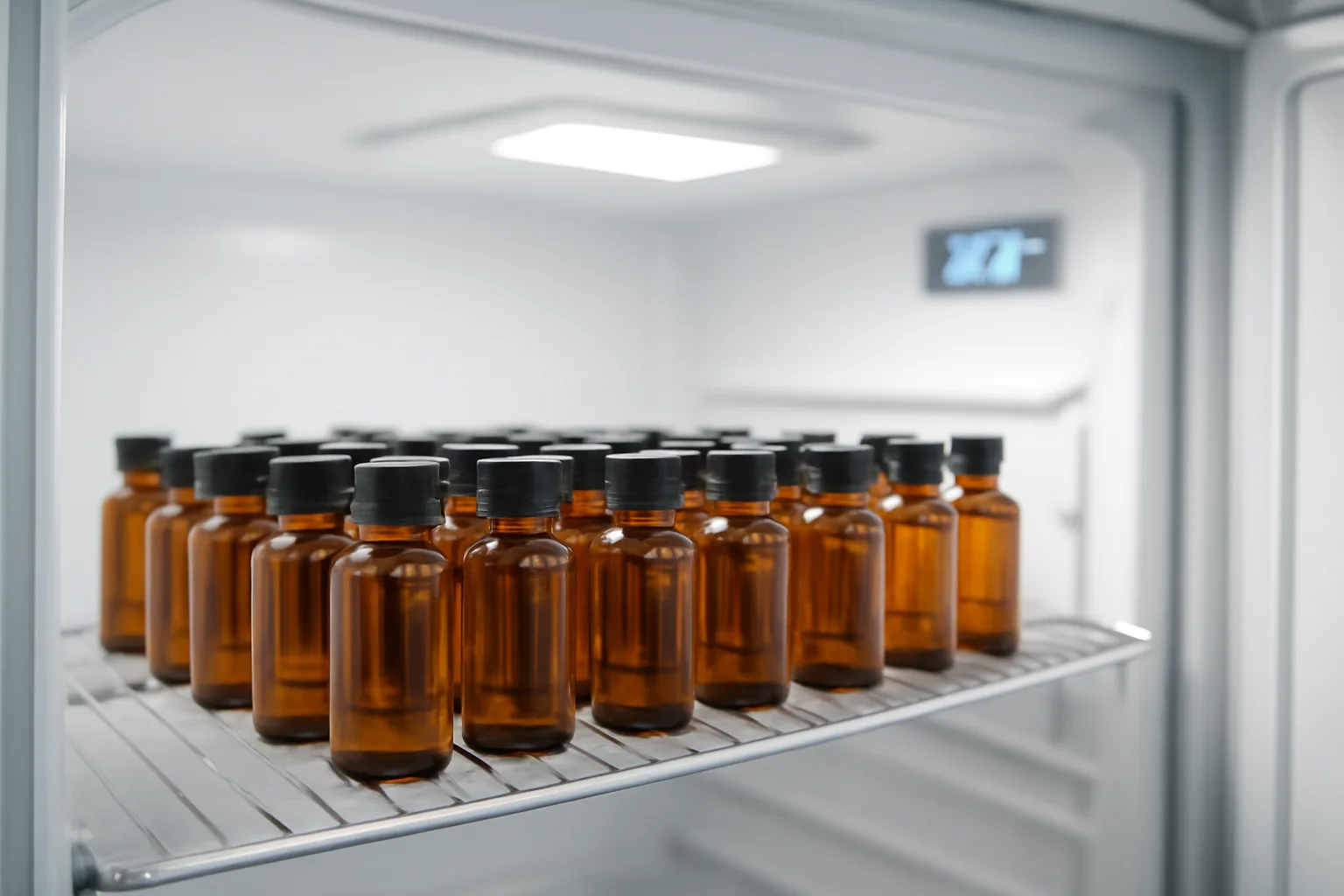
The copper ion in GHK-Cu makes the molecule slightly more sensitive to light and oxidation, which reinforces the need for refrigeration and opaque vials. Copper peptides are coordination complexes. The copper ion is chelated (held) by the amino acids. When GHK-Cu is stable, copper is part of the therapeutic effect [4]. If the peptide degrades, you can get free copper, which is a different animal. Free copper catalyzes oxidation reactions and generates reactive oxygen species that damage cells instead of helping them. Most injectable peptides ship in amber or opaque vials to block UV light, which accelerates oxidation. If you ever see GHK-Cu in a clear glass vial, transfer it to an amber vial or keep it in a dark container. Even refrigerator light during repeated access can start breaking down copper complexes over weeks. There's no evidence that brief light exposure during injection prep harms a dose, but cumulative exposure over the vial's life does matter. This is why some practitioners recommend drawing all your doses into individual syringes at once, capping them, and refrigerating the loaded syringes. You minimize the number of times the vial is exposed to light and air.
What about GHK-Cu in hydrogels or other advanced formulations?
Advanced delivery systems like hydrogels, hyaluronic acid conjugates, or hydroxyapatite microspheres often have different storage profiles, and you should follow the specific product's instructions. A 2025 study on GHK-Cu-loaded hydroxyapatite microsphere fillers for injectable use reported stable storage at 4°C for up to 90 days, significantly longer than a basic aqueous solution [5]. The microsphere matrix protects the peptide from hydrolysis. Similarly, GHK-Cu conjugated to hyaluronic acid (where the peptide is covalently bonded to HA) showed enhanced stability in formulations stored at room temperature compared to free GHK-Cu [6]. Food-derived tripeptide hydrogels designed for wound healing have been formulated with self-healing properties and antimicrobial features that extend room-temperature shelf life [7]. These are medical device-adjacent products and come with validated stability data. If you're using a research-stage or provider-prepared advanced formulation, the compounding pharmacy or research supplier will give you storage instructions that reflect the carrier system. Don't assume these products follow the same rules as plain peptide in water. Some are more durable; some are more fragile. Read the label.
How does GHK-Cu storage compare to other peptides?
GHK-Cu storage requirements are typical for small peptides in aqueous solution. BPC-157, TB-500, and CJC-1295 all follow the same 7-14 day refrigerated rule after reconstitution. The peptide therapy field doesn't have uniform shelf-life standards. What you see in practice is a patchwork of manufacturer claims, pharmacy beyond-use dates, and user habits. The conservative approach (14 days refrigerated for any reconstituted peptide) comes from sterile compounding guidelines in USP <797>, which most compounding pharmacies follow [1]. GHK-Cu may be slightly more finicky than some peptides because of the copper ion. Copper coordination complexes are sensitive to pH and ionic strength. If your bacteriostatic water has a pH outside the 5.5-7.5 range, the complex can dissociate faster. Most suppliers don't publish pH for bacteriostatic water, so you're operating on trust that it's appropriate. Anecdotally, some peptides (like BPC-157) tolerate room temperature for a few hours without obvious degradation, and people get sloppy. GHK-Cu is not one of those. The wound-healing and anti-inflammatory effects documented in mice and ex-vivo studies come from the intact copper-peptide complex [8]. If you're breaking that structure through poor storage, you're not using GHK-Cu anymore; you're using fragments and free copper.
Where can I get properly stored GHK-Cu for injection?
Properly stored injectable GHK-Cu comes from compounding pharmacies operating under 21 U.S.C. 353a (503A) or 21 U.S.C. 353b (503B), with a prescription or provider order and cold-chain shipping. GHK-Cu is not on the FDA's approved drug list, so it's only legally available via compounding for individual patients. The bulk substance must be on the 503A or 503B bulk drug list (21 CFR 216.23 or 21 CFR 216.24) or meet nomination criteria [9] [10]. The pharmacy must have state and federal oversight, and the product must be prepared in a sterile environment and shipped with appropriate cold-chain logistics. CopperPeptideDirect.com works with licensed compounding pharmacies that prepare GHK-Cu under these standards. You consult with a healthcare provider who reviews your case, writes an order, and the pharmacy prepares a patient-specific formulation. It arrives refrigerated or frozen with ice packs, labeled with beyond-use date, storage instructions, and lot traceability. You'll also find GHK-Cu vials sold by research chemical suppliers marked "not for human use." These are gray-market products with no pharmacy oversight, no sterility guarantees, and no recourse if the product is contaminated or degraded. Storage conditions during manufacturing, warehousing, and shipping are unknown. Some arrive already at room temperature. If you're considering injection, this is a safety gamble that isn't worth saving a few dollars. The provider-reviewed route ensures you're using a product that was stored correctly from synthesis to your doorstep, and you have documentation and support if something goes wrong. That matters when you're injecting a biologically active molecule.
Frequently asked questions
Can I freeze and thaw GHK-Cu multiple times?
No. Each freeze-thaw cycle degrades peptide structure. If you need to freeze reconstituted GHK-Cu, divide it into single-use aliquots (tuberculin syringes work) so you only thaw what you need that day. One freeze-thaw cycle is acceptable; three or four will noticeably reduce potency.
Does lyophilized GHK-Cu need to be refrigerated before opening?
No. Sealed lyophilized vials are stable at room temperature (15-25°C) for 12-24 months. Refrigeration doesn't hurt and can extend shelf life slightly, but it's not required until after reconstitution. Keep the vial in a dry, dark place.
How do I know if my reconstituted GHK-Cu has gone bad?
Visible signs include cloudiness, color change (any yellowing or darkening), or particles floating in the solution. Discard immediately if you see any of these. Clear solution doesn't guarantee full potency past 14 days, but contamination is usually obvious. When in doubt, toss it.
Can I store GHK-Cu in a mini-fridge in my bedroom?
Yes, as long as the fridge maintains 2-8°C consistently. Check it with a refrigerator thermometer. Some mini-fridges cycle temperature widely or freeze items near the cooling element. A stable, dedicated fridge for peptides is better than a dorm-style unit that's opened 20 times a day.
What's the shelf life of GHK-Cu topical serums?
Most preserved commercial serums list 12-18 months from manufacture at room temperature. Refrigerating them may extend effectiveness, especially for liposomal formulations. Unpreserved compounded topical preparations last 30-60 days refrigerated. Check the label for the beyond-use date or expiration.
Is it safe to use GHK-Cu that was left out overnight?
Not for injectable use. A reconstituted vial left at room temperature overnight (8-12 hours) may have partial degradation and increased bacterial risk if not handled with sterile technique. For a topical serum with preservatives, one night is probably fine, but I wouldn't make a habit of it.
Do I need to refrigerate GHK-Cu during the injection process?
No. Peptides tolerate brief room-temperature exposure (15-30 minutes) during prep and injection without meaningful degradation. Draw your dose, cap the vial, return it to the fridge, and inject. Don't leave the vial sitting out on a counter for hours.
Can I store GHK-Cu in a cooler with ice packs long-term?
No. Ice packs lose temperature within 12-24 hours, and temperature fluctuations (cycling between cold and warm as packs thaw) are worse than stable refrigeration. Use a cooler for transport only. For long-term storage, use a real refrigerator or freezer.
Does GHK-Cu need light protection during storage?
Yes. GHK-Cu is light-sensitive because of the copper component. Most injectable vials are amber glass to block UV light. Store the vial in its original packaging or a dark container inside the fridge. Avoid prolonged exposure to direct sunlight or bright indoor light.
What should I do if my GHK-Cu shipment arrives warm?
Contact the compounding pharmacy or supplier immediately. They should offer a replacement if cold-chain integrity was compromised. Don't inject a peptide that spent days at room temperature during shipping. Most reputable providers use 2-day shipping with tracking and temperature monitoring.
Can I extend GHK-Cu shelf life by adding more bacteriostatic water?
No. Adding more bacteriostatic water dilutes the peptide and may inhibit bacteria slightly longer, but it does nothing to prevent peptide hydrolysis. The beyond-use date is based on the peptide's chemical stability, more than bacterial growth. Follow the original 14-day guideline.
How cold is too cold for storing GHK-Cu?
Standard freezing (-20°C) is acceptable if the formulation tolerates it (ask your pharmacy). Temperatures below -80°C (deep freezers used for long-term biobanking) are unnecessary and impractical at home. Don't freeze a vial in a poorly sealed chest freezer where it can sublimate or be exposed to temperature cycling.
Does the type of bacteriostatic water affect GHK-Cu storage?
Yes, slightly. Bacteriostatic water with 0.9% benzyl alcohol is standard. Some suppliers use bacteriostatic saline (0.9% NaCl with benzyl alcohol). Saline can affect the copper-peptide complex if the ionic strength is very high or very low, but commercially available bacteriostatic solutions are generally appropriate. Don't use plain sterile water; it has no preservative.
What's the best way to store multiple peptides in one fridge?
Store each vial upright in a labeled container (a small plastic bin works). Keep insulin, peptides, and other injectables in a designated area away from food to avoid cross-contamination and accidental mix-ups. Check expiration and beyond-use dates weekly. Discard anything past its date.
Sources
- 21 U.S.C. 353a (Pharmacy Compounding): Compounding pharmacies must assign beyond-use dates based on formulation stability.
- Molecules (Liposomal GHK-Cu encapsulation monitoring, 2025): Liposomal GHK-Cu encapsulation efficiency dropped 12-18% after 90 days at 25°C compared to 4°C storage.
- International Journal of Molecular Sciences (GHK-Cu gene regulation, 2018): Free copper ions can generate reactive oxygen species when GHK-Cu structure degrades.
- Journal of Biomaterials Science, Polymer Edition (GHK tissue remodeling, 2008): The copper-peptide complex is essential for GHK-Cu's tissue remodeling effects.
- Colloids and Surfaces B: Biointerfaces (GHK-Cu hydroxyapatite microspheres, 2025): GHK-Cu-loaded hydroxyapatite microspheres remained stable at 4°C for up to 90 days.
- Bioconjugate Chemistry (GHK-hyaluronan conjugates, 2025): GHK-Cu conjugated to hyaluronic acid showed enhanced stability compared to free GHK-Cu.
- Biomaterials Research (Food-derived tripeptide hydrogel, 2025): Food-derived tripeptide hydrogels formulated with antimicrobial features extended room-temperature shelf life.
- Wound Repair and Regeneration (GHK-Cu-liposome wound healing, 2017): GHK-Cu-liposomes promoted wound healing in mice through proliferation and angiogenesis.
- 21 CFR 216.23 (503A Bulk Substances List): Bulk substances for 503A compounding must be on the FDA's approved list or meet nomination criteria.
- FDA Bulk Drug Substances for 503A Compounding: GHK-Cu availability for compounding depends on bulk substance nomination and FDA evaluation.