Last updated 2026-07-24
TL;DR
You can use topical copper peptides after microneedling, but timing matters. Most practitioners recommend waiting at least 12-24 hours after the procedure to let the barrier begin resealing before applying active peptides. Injectable GHK-Cu is a separate route with different considerations and should only be performed by qualified providers under controlled conditions, not mixed with aesthetic microneedling protocols.
What happens to skin immediately after microneedling?
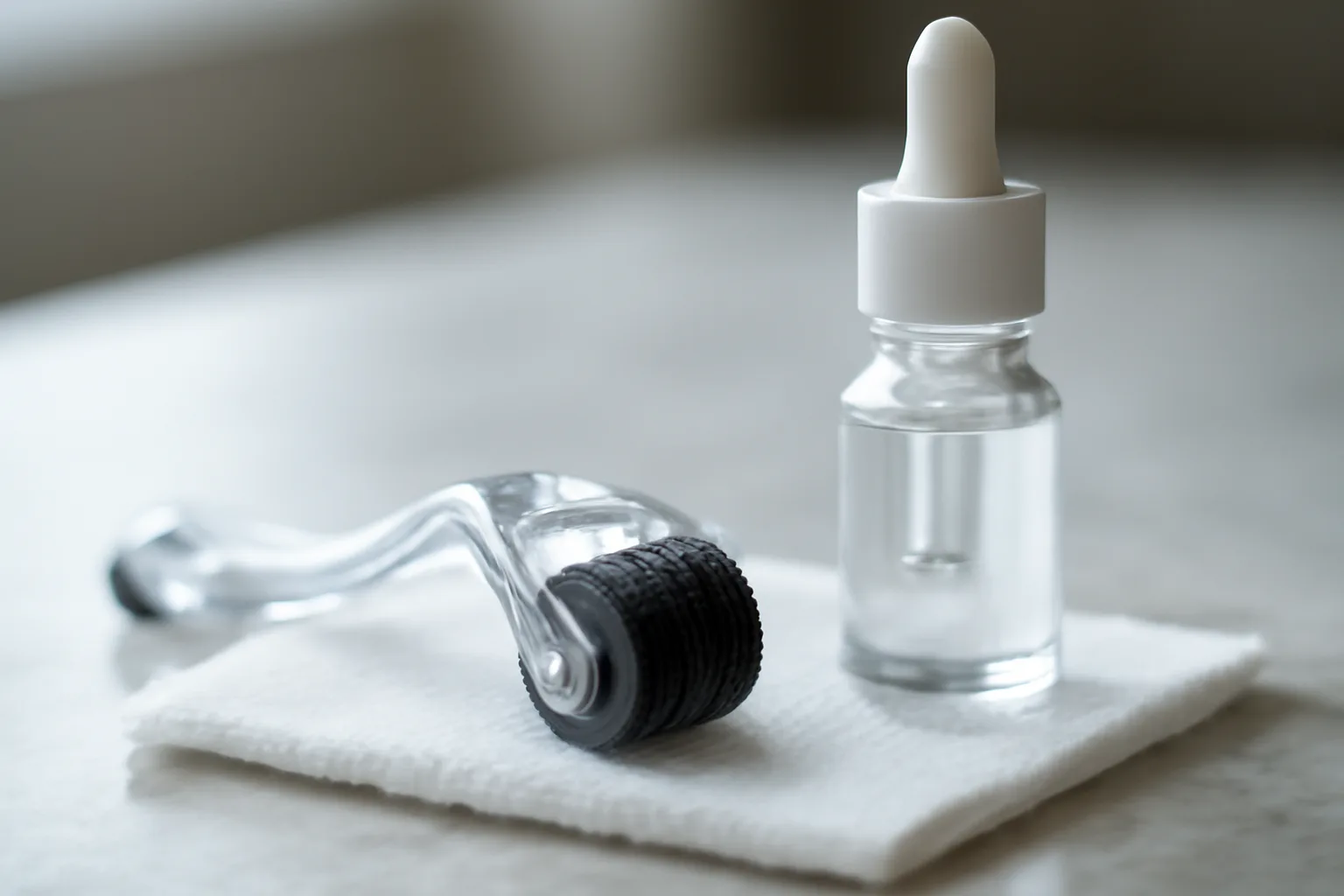
Microneedling creates thousands of controlled micro-injuries in the dermis to trigger wound repair. The skin barrier is temporarily compromised. Your epidermis has open channels for roughly 12-48 hours depending on needle depth. A 0.25mm cosmetic roller creates superficial trauma that closes faster. A 1.5mm medical-grade session leaves deeper punctures that take longer to seal. During this window, transdermal absorption increases dramatically. That's the reason people microneedle before applying actives in the first place. But it also means anything you put on can penetrate much deeper than intended. Copper absorption through intact skin is minimal. Through microneedling channels, you're bypassing the stratum corneum entirely. The peptide and its copper cargo have direct access to blood vessels in the dermis.
Does research support copper peptides for post-needling healing?
The wound-healing literature on GHK-Cu is extensive but almost none of it tests the compound applied immediately post-microneedling. A 2017 study found GHK-Cu liposomes accelerated scald wound healing in mice by promoting cell proliferation and angiogenesis [1]. A 2008 review noted GHK's role in tissue remodeling and collagen synthesis [2]. A 2023 study demonstrated that GHK-Cu combined with hyaluronic acid upregulated collagen IV in fibroblast and ex-vivo skin models [3]. Those findings tell us GHK-Cu can support healing in wounded tissue. They don't tell us whether applying it to thousands of fresh puncture wounds is safe or improves outcomes compared to waiting. Most microneedling protocols use simple serums (hyaluronic acid, growth factors) or nothing at all in the first 24 hours. Copper peptides enter the routine later, during the remodeling phase.
What are the risks of applying copper peptides too soon?
Three concerns come up: excessive copper absorption, irritation, and infection risk. Copper is an essential trace mineral but it's also a pro-oxidant at high local concentrations. Your body tightly regulates systemic copper through ceruloplasmin and metallothionein binding. When you flood open dermal channels with a copper complex, you're bypassing those controls. No human studies have measured serum copper after topical GHK-Cu on microneedled skin. We don't know how much gets into circulation or how fast. A 2025 review noted that measuring skin permeation of encapsulated GHK-Cu remains methodologically challenging [4], so real-world absorption data is sparse even for intact skin. Irritation is more predictable. Fresh microneedle wounds are inflamed by design. Adding an active peptide before inflammation resolves can intensify redness, burning, or peeling. Some people tolerate it fine. Others get contact dermatitis that delays healing instead of accelerating it. Infection risk is theoretical but real. Microneedling punctures your skin. Any product you apply in the first hours can carry bacteria into those channels. Topical copper peptide serums are not sterile pharmaceutical preparations. They're cosmetic formulations made in facilities that follow Good Manufacturing Practices for cosmetics, which is a much lower bar than injectable sterility.
What do practitioners actually recommend for timing?
The standard advice is to wait 12-24 hours after microneedling before applying copper peptides or any other active serum. Some clinics use a gentler active (like hyaluronic acid or a growth factor serum) immediately post-needling, then introduce copper peptides on day two or three. Others tell patients to use only a bland emollient or nothing at all for the first 24 hours. There's no consensus protocol. Microneedling itself isn't standardized. Needle depth, speed, pattern, and device vary wildly from a $30 home roller to a $400 clinic session with a powered pen. If you're microneedling at home with a short roller (0.25-0.5mm), waiting 12 hours is probably conservative. If you had a 1.5mm medical session, waiting 24-48 hours makes more sense. One dermatology clinic I've seen suggests applying GHK-Cu starting 48 hours post-procedure and continuing daily for two weeks. Another uses it the morning after a 0.5mm session. Both report good outcomes. Neither has published controlled data.
Can I inject GHK-Cu after microneedling?
Injectable GHK-Cu peptides and microneedling are separate interventions. You wouldn't typically do both in the same session. Microneedling is a surface procedure. Injectable peptides are administered subcutaneously or intramuscularly, sometimes intradermally for specific indications. The delivery route and dosing are completely different from topical application. If you're considering injectable GHK-Cu, that's a conversation with a prescribing physician or qualified provider. It's not something you do at home and it's not something you layer on top of a microneedling appointment. A 2026 review of injectable peptides in orthopaedics noted that GHK-Cu has been studied in animal models for tissue repair but remains largely unapproved for human injectable use in the United States [5]. Another 2026 sports medicine review emphasized that most peptide therapies lack FDA approval for musculoskeletal indications and carry uncertain safety profiles [6]. GHK-Cu is not on the FDA's 503A bulk drug substances list [7] or the 503B list [8], which means it cannot be legally compounded as a sterile injectable in the U.S. under federal rules. Some clinics source it anyway. That's a regulatory and safety problem, not a clinical recommendation. If you're using a provider-reviewed GHK-Cu source that works through a licensed pharmacy partner, you're at least assured of pharmaceutical-grade peptide and proper compounding. But even then, injection is a medical procedure with its own risks.
What does the safety record look like for GHK-Cu?
Topical GHK-Cu has a long cosmetic track record with few reported adverse events. It's been in serums and creams since the 1980s. A 2025 review called it "one of the most promising anti-aging peptides" but noted that formulation stability and skin penetration remain challenges [9]. A 2020 aging research review highlighted GHK's gene-regulatory effects but acknowledged that most evidence comes from cell culture and animal models [10]. Serious side effects from topical use are rare. Mild irritation, contact dermatitis, and transient redness are the main complaints, usually in people using high concentrations or combining it with other actives like retinoids or acids. No studies have tracked long-term systemic copper accumulation from repeated topical GHK-Cu use. Copper toxicity is real but typically requires much higher exposures (occupational, genetic disorders like Wilson's disease, contaminated water). A cosmetic serum applied a few times a week is unlikely to cause copper overload. Injectable safety data in humans is thin. A 2015 rat study found that GHK-Cu injection transiently improved ACL reconstruction healing but the effect faded over time [11]. The study used a single injection, not repeated dosing. We don't know what happens with chronic injectable use in people.
How do I choose a copper peptide product for post-microneedling use?
Formulation matters. You want a product designed for compromised skin, not a high-concentration active serum meant for intact barriers. Look for GHK-Cu in a liposomal or encapsulated delivery system. A 2023 study on liposomal GHK-Cu found that encapsulation improved stability and allowed controlled release [12]. A 2025 study demonstrated that liposomes could protect GHK-Cu from degradation and modulate its permeation [4]. Liposomal formulations release peptide gradually, which reduces the risk of overwhelming fresh microneedle wounds with a bolus of copper. Concentration typically ranges from 0.5% to 3% GHK-Cu in cosmetic serums. For post-microneedling, start with a lower concentration. You can always move up if your skin tolerates it. Avoid products with multiple actives. Post-needling is not the time to layer on vitamin C, retinol, and copper peptides all at once. Keep it simple for the first week. If you're using a provider-reviewed preparation, ask about the intended use case. Some compounded formulations are designed for injection, others for topical application. They're not interchangeable.
What's the difference between cosmetic-grade and provider-dispensed GHK-Cu?
Cosmetic-grade GHK-Cu is sold as a serum or cream, regulated as a cosmetic, and manufactured under Good Manufacturing Practices for cosmetics (21 CFR 700-740). It doesn't require a prescription. Provider-dispensed GHK-Cu, if compounded by a licensed pharmacy, is regulated as a drug under section 503A or 503B of the Federal Food, Drug, and Cosmetic Act [13]. It requires a prescription or provider relationship and must meet stricter purity and sterility standards. As noted earlier, GHK-Cu is not currently on the FDA's approved bulk substances lists for compounding [7][8]. That means any compounded preparation is technically off-list, which puts the legal burden on the prescriber and compounder to justify its use. Some providers who offer injectable peptides work with specialty pharmacies that compound GHK-Cu despite its off-list status. Others won't touch it because of regulatory uncertainty. For topical post-microneedling use, most people use a cosmetic-grade product. For injectable use, you need a provider willing to prescribe and a pharmacy willing to compound. The market for buying GHK-Cu is split between these two very different tracks.
Can I combine GHK-Cu with other peptides after microneedling?
You can, but simplicity is safer in the first 48 hours. Microneedling already stresses your skin. Adding multiple peptides increases the chance of irritation or an unexpected reaction. GHK-Cu is often paired with hyaluronic acid in commercial formulations. A 2023 study found that the two worked together to upregulate collagen IV [3]. Hyaluronic acid is also hydrating and soothing, which makes it a good post-needling companion. Other peptides like Matrixyl (palmitoyl pentapeptide-4) or argireline (acetyl hexapeptide-8) are sometimes combined with GHK-Cu in anti-aging serums. There's no direct evidence that these combinations work better or worse after microneedling specifically. If you want to use multiple peptides, introduce them one at a time. Start with GHK-Cu for a week, then add the next one. That way if you react, you know which ingredient caused it. Growth factors (EGF, TGF-beta, PDGF) are a separate category. Some microneedling clinics apply growth factor serums immediately post-procedure. Whether you can also use copper peptides depends on the specific products and your provider's protocol.
What about long-term use of GHK-Cu after a microneedling series?
Most people who microneedle do it as a series: four to six sessions spaced four weeks apart. The question becomes whether to use GHK-Cu continuously between sessions or cycle it. Continuous daily use is common and generally well-tolerated. A 2018 review noted GHK-Cu's regenerative and protective actions across multiple gene pathways, suggesting benefit from sustained exposure [14]. Some practitioners recommend using it for two weeks after each session, then taking a break until the next needling appointment. The logic is that wound healing is most active in the first two weeks. After that, you're just maintaining. No study has compared these strategies. It's all clinical experience and patient preference. One consideration is copper accumulation over months of daily use. Your liver and kidneys handle excess copper well, but if you're also taking a multivitamin with copper or eating a lot of shellfish and organ meats, you're stacking sources. Nobody has good data on cumulative copper exposure from cosmetic peptides. It's probably fine. But it's also unmapped territory. If you notice side effects like persistent irritation, breakouts, or a metallic taste (a sign of systemic copper excess, though rare), stop using the peptide and talk to your provider.
Frequently asked questions
How long after microneedling can I use copper peptides?
Wait at least 12-24 hours after microneedling before applying topical copper peptides. This gives your skin barrier time to begin resealing the micro-channels. Some practitioners recommend waiting 48 hours after deeper medical-grade sessions (1.5mm or more). Starting too soon increases the risk of excessive copper absorption and irritation.
Is it safe to apply GHK-Cu immediately after microneedling?
Not recommended. Microneedling creates thousands of open channels that dramatically increase absorption. Applying GHK-Cu before these channels close can deliver more copper than intended and bypass your body's normal regulatory mechanisms. The risk of irritation, inflammation, or contact dermatitis is higher when active peptides meet fresh wounds.
Can I inject GHK-Cu after microneedling?
Injectable GHK-Cu and microneedling are separate interventions, not combined in the same session. Injectable peptides require a prescribing provider and pharmaceutical-grade compounding. GHK-Cu is not on the FDA's approved bulk substances lists for compounding in the U.S., which complicates legal access. Discuss injectable options with a qualified physician, not as an add-on to a microneedling appointment.
Does copper peptide speed up healing after microneedling?
Lab and animal studies show GHK-Cu supports wound healing, collagen synthesis, and angiogenesis. A 2017 mouse study found GHK-Cu liposomes accelerated scald wound healing. A 2023 study showed combined effects with hyaluronic acid for collagen IV upregulation. But no controlled trials have tested GHK-Cu specifically on human microneedling wounds. The existing evidence suggests potential benefit, but timing and formulation matter.
What concentration of GHK-Cu should I use after microneedling?
Start with a lower concentration, 0.5-1%, for the first week after microneedling. Your skin barrier is compromised, so absorption is higher than normal. You can move up to 2-3% concentrations once healing progresses if your skin tolerates it. Liposomal or encapsulated formulations release peptide gradually, which is safer for compromised skin than a high-concentration free peptide serum.
Can I use retinol and copper peptides after microneedling?
Not at the same time in the first week. Retinol and copper peptides are both active ingredients that can irritate healing skin. Most practitioners recommend waiting 3-7 days after microneedling before reintroducing retinol, then alternating nights (retinol one night, copper peptide the next) rather than layering them. Some evidence suggests copper may degrade retinol, so separation is prudent.
What are the side effects of using copper peptides too soon after microneedling?
Excessive redness, burning, peeling, or contact dermatitis. Rarely, systemic copper absorption could cause nausea or a metallic taste, though this is uncommon with topical use. The main risk is intensifying inflammation at a time when your skin is already inflamed from controlled injury. This can delay healing rather than accelerate it.
How do I know if my GHK-Cu serum is safe for post-microneedling use?
Look for products formulated with liposomal or encapsulated delivery, which release peptide gradually. Avoid serums with multiple strong actives (vitamin C, acids, retinol) in the same formulation. Check that the product is made by a reputable manufacturer following Good Manufacturing Practices. If you're using a provider-dispensed preparation, confirm it's intended for topical use, not injection.
Can I use copper peptides before microneedling?
Some clinics apply a thin layer of serum (including copper peptides) immediately before microneedling to help the device glide and deliver actives during the procedure. This is controversial. Others apply nothing, preferring to introduce actives only after the initial inflammation settles. There's no standard protocol. If your provider uses pre-needling serums, ask what's in them and why.
Do I need a prescription for copper peptides after microneedling?
No, not for topical cosmetic-grade GHK-Cu. You can buy serums over the counter or online. Injectable GHK-Cu, if you're considering that route for any reason, requires a prescribing provider and access to a compounding pharmacy, and currently has uncertain regulatory status in the U.S. because GHK-Cu is not on the FDA's approved bulk substances lists.
How long should I use GHK-Cu after a microneedling session?
A typical recommendation is daily use for 2-4 weeks after each session. Wound healing is most active in the first two weeks. Some people continue daily use between microneedling sessions (usually spaced four weeks apart), others cycle off. No studies have compared continuous vs. intermittent use. Both approaches are common in practice.
Can I combine GHK-Cu with hyaluronic acid after microneedling?
Yes. Hyaluronic acid is hydrating, soothing, and safe for compromised skin. A 2023 study found that GHK-Cu and hyaluronic acid worked together to upregulate collagen IV in skin models. Many post-microneedling protocols include hyaluronic acid in the first 24 hours, then introduce copper peptides after the barrier begins to reseal. The combination is well-tolerated.
What's the difference between topical and injectable GHK-Cu for microneedling recovery?
Topical GHK-Cu is a cosmetic serum applied to the skin surface, designed to penetrate gradually. Injectable GHK-Cu is a pharmaceutical-grade preparation administered subcutaneously or intramuscularly by a provider, delivering a bolus dose directly into tissue. They're not used together in a microneedling context. Topical is the standard route for post-needling skin care. Injectable is a separate medical intervention with different risks and legal status.
Does GHK-Cu cause copper toxicity with repeated microneedling?
Copper toxicity from topical GHK-Cu is extremely rare. Your liver and kidneys regulate systemic copper effectively. Microneedling increases absorption, but a cosmetic serum applied a few times after each session is unlikely to cause overload. Long-term daily use across multiple needling series is less studied. If you're concerned, avoid other copper sources (multivitamins with copper, excessive shellfish) and monitor for symptoms like a metallic taste or nausea.
Sources
- Wound Repair and Regeneration, 2017: GHK-Cu liposomes accelerated scald wound healing in mice by promoting cell proliferation and angiogenesis
- Journal of Biomaterials Science, Polymer Edition, 2008: GHK's role in tissue remodeling and collagen synthesis
- Journal of Cosmetic Dermatology, 2023: GHK-Cu combined with hyaluronic acid upregulated collagen IV in fibroblast and ex-vivo skin models
- Molecules, 2025: Measuring skin permeation of encapsulated GHK-Cu remains methodologically challenging; liposomes protect GHK-Cu from degradation and modulate permeation
- Journal of the American Academy of Orthopaedic Surgeons, Global Research & Reviews, 2026: GHK-Cu has been studied in animal models for tissue repair but remains largely unapproved for human injectable use
- Sports Medicine, 2026: Most peptide therapies lack FDA approval for musculoskeletal indications and carry uncertain safety profiles
- 21 CFR 216.23, FDA 503A Bulks List: GHK-Cu is not on the FDA's 503A bulk drug substances list for pharmacy compounding
- 21 CFR 216.24, FDA 503B Bulks List: GHK-Cu is not on the FDA's 503B bulk drug substances list for outsourcing facilities
- BioImpacts, 2025: Topically applied GHK described as a promising anti-aging peptide, with formulation stability and skin penetration noted as challenges
- Aging Pathobiology and Therapeutics, 2020: GHK's gene-regulatory effects highlighted, with most evidence from cell culture and animal models
- Journal of Orthopaedic Research, 2015: GHK-Cu injection transiently improved ACL reconstruction healing in a rat model
- Pharmaceutics, 2023: Liposomal encapsulation of GHK-Cu improved stability and allowed controlled release
- 21 U.S.C. 353a, Pharmacy Compounding: Provider-dispensed compounded drugs are regulated under section 503A or 503B of the Federal Food, Drug, and Cosmetic Act
- International Journal of Molecular Sciences, 2018: GHK-Cu's regenerative and protective actions across multiple gene pathways