Last updated 2026-07-24
TL;DR
You can't get GHK-Cu itself from food. Diet only raises baseline copper (organ meats, shellfish, nuts, seeds), while the actual GHK-Cu tripeptide your body makes declines with age and has to be replaced through topical serums or provider-dispensed compounded formulas, which are different products with different oversight.
Can you actually get copper peptides from food or diet?
No, not the specific tripeptide. Food gives you copper, the mineral, not GHK-Cu, the peptide-copper complex your liver makes naturally by combining copper with a small protein fragment. They are not the same thing, and eating more copper-rich food does not mean your body assembles more GHK-Cu. GHK (glycyl-L-histidyl-L-lysine) is a naturally occurring human tripeptide first isolated from plasma, and it binds copper with very high affinity to form the GHK-Cu complex studied in dozens of papers on skin repair, wound healing, and tissue remodeling [1]. Your body produces it as part of normal tissue turnover, largely tied to wound signaling and copper homeostasis, not to what's on your plate that day. So when people search for how to get copper peptides naturally, there are really two separate questions hiding in there. One is 'how do I get more dietary copper' (easy, food does that). The other is 'how do I get more GHK-Cu activity in my skin or blood' (harder, and diet alone does not do it).
What foods are naturally high in copper?
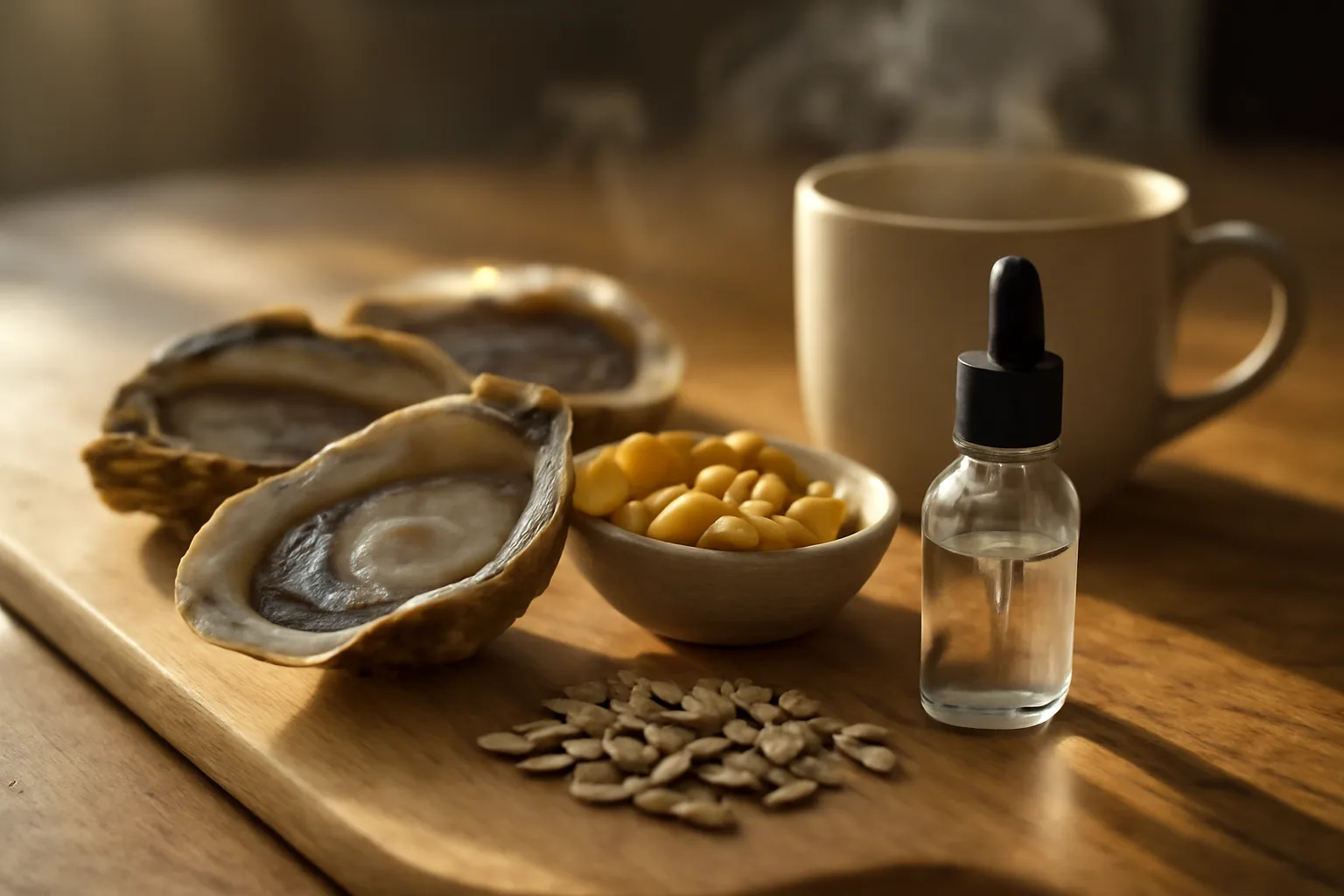
Organ meats, shellfish, nuts, seeds, and dark chocolate are the standout copper sources in a normal diet. Beef liver is one of the most concentrated sources around, oysters and other shellfish are close behind, and cashews, sesame seeds, and sunflower seeds all contribute meaningfully if you eat them regularly. Other solid contributors include mushrooms (especially shiitake), leafy greens, whole grains, and legumes like chickpeas and lentils. Dark chocolate with high cacao content also carries a fair amount of copper per serving. Eating these foods keeps your copper status normal, which matters for enzymes like lysyl oxidase and ceruloplasmin that your body uses in collagen crosslinking and iron metabolism. But none of the research on GHK-Cu and skin or wound healing was done by feeding subjects copper-rich meals. It was done with the isolated peptide-copper complex applied topically or, in newer orthopedic and injectable-peptide research, delivered by injection [2][3].
Does your body make GHK-Cu naturally, and does that decline with age?
Yes. GHK-Cu is present in human plasma and its concentration is well documented to drop as people get older, which is part of why researchers got interested in replacing it topically or systemically in the first place. A 2018 review in the International Journal of Molecular Sciences lays out the gene-level evidence for GHK-Cu's regenerative and protective actions, tying it to broad effects on tissue remodeling and cellular repair pathways [1]. A separate 2020 review focused specifically on GHK's potential as an anti-aging peptide, summarizing how its natural decline correlates with reduced tissue repair capacity over a lifespan [4]. This is the biological rationale behind topical GHK-Cu products: the idea is not to add something foreign, but to replace a compound your body used to make more of. That rationale is legitimate as far as it goes. It does not mean applying a cream restores youthful GHK-Cu levels throughout the body. Topical application changes local skin conditions; it is not the same as restoring systemic peptide levels.
What's the difference between topical and injectable copper peptides?
Topical GHK-Cu is what's in cosmetic serums and creams, applied to skin, and it has the deepest research record of any route. Injectable GHK-Cu is a different category entirely, studied mostly in animal models for wound healing, orthopedic tissue repair, and inflammation, and it carries different absorption, dosing, and safety considerations that do not carry over from the skincare literature. The cosmetic dermatology studies (liposome encapsulation, skin permeation, collagen IV upregulation with hyaluronic acid) are almost entirely topical [5][6][7]. A 2025 study in Molecules specifically questioned whether current methods are even good enough to measure how much GHK-Cu actually penetrates skin when delivered in liposomes, which tells you the permeation question is still open, not settled [5]. Injectable and implanted GHK-Cu research is a newer and much smaller body of work. It includes a 2025 study of an injectable hydroxyapatite microsphere filler loaded with GHK-Cu for anti-inflammatory and antioxidant effects [8], and older orthopedic work like a 2015 rat model of ACL reconstruction where a GHK-Cu(II) complex produced a transient improvement in healing outcomes, meaning the benefit did not persist through the full study period [9]. A 2026 primer in the American Journal of Sports Medicine reviews injectable peptide therapy broadly for orthopedic and sports medicine use, and a companion 2026 review in the Journal of the American Academy of Orthopaedic Surgeons Global Research & Reviews covers applications and open challenges for therapeutic peptides in orthopedics generally [2][3]. None of this is the same evidence base as a wrinkle serum, and readers comparing ghk-cu peptides injections to a topical product should treat them as separate questions with separate risk profiles. If you want the fuller before-and-after picture across both delivery routes, the ghk-cu peptide injection before and after page walks through what's actually been documented versus what's marketing extrapolation.
Is there a supplement that raises GHK-Cu levels naturally?
Not one with real human trial data behind it. Oral copper supplements raise blood copper, but they do not verifiably raise GHK-Cu tripeptide levels specifically, because GHK-Cu formation depends on peptide synthesis and binding, more than copper availability. Most of the 'natural GHK-Cu' claims online conflate the two. Copper bisglycinate, copper gluconate, and multivitamin copper are all reasonable ways to correct a copper deficiency if you have one, which is genuinely uncommon in people eating a varied diet. They are not a documented way to boost the specific tripeptide-copper complex studied in the dermatology and wound-healing literature. Some of the more interesting recent GHK-Cu research isn't about supplementation at all. A 2026 study in Biogerontology found that GHK-Cu delayed aging markers in C. elegans (roundworms) through coordinated regulation of mitochondrial function and activation of DAF-16/SKN-1 pathways [10]. That is a real and specific mechanistic finding, in a worm, and it is a long way from a human dosing recommendation you'd act on from a supplement bottle.
What does the actual skin research on GHK-Cu show?
The strongest, most repeated finding is that topical GHK-Cu increases signals associated with collagen and tissue remodeling in skin cell and ex-vivo models, and it has one of the deeper mechanistic literatures of any cosmetic peptide. A 2023 study in the Journal of Cosmetic Dermatology found that combining GHK-Cu with hyaluronic acid produced a synergistic upregulation of collagen IV in fibroblast cultures and ex-vivo skin tests, meaning the two together did more than either alone [7]. A 2025 review in BioImpacts specifically addressed GHK as an anti-wrinkle peptide, walking through both the advantages of the mechanism and the real problems with delivery, stability, and evidence quality in commercial products [11]. That review is worth reading precisely because it does more than cheerlead; it flags the gap between laboratory mechanism and proven cosmetic outcome. On the wound-healing side, a 2017 study found that GHK-Cu encapsulated in liposomes accelerated scald wound healing in mice by promoting cell proliferation and angiogenesis (new blood vessel formation) [12]. That's an animal burn model, not a human trial, but it is one of the more concrete efficacy signals in the whole GHK-Cu literature and it is a large part of why formulators use liposome encapsulation rather than plain aqueous serums. Formulation quality matters a lot here. A 2023 paper in Pharmaceutics on liposomes as carriers for GHK-Cu in cosmetic products, and a related 2024 Electrophoresis paper using CE-ICP-MS/MS to actually measure how much GHK-Cu ends up encapsulated, both point to the same practical issue: a lot of commercial serums never publish or verify what fraction of their GHK-Cu is actually bioavailable in the finished product [6][13].
Does GHK-Cu do anything for hair, or is that just marketing?
The hair claims mostly ride on the same tissue-remodeling and anti-inflammatory mechanism documented for skin, not on dedicated human hair-growth trials. The foundational 2008 paper on GHK and tissue remodeling in the Journal of Biomaterials Science laid out the broad regenerative signaling GHK-Cu participates in, which is the mechanistic basis most hair-product marketing leans on [14]. That paper is real and it is a legitimate starting point for research interest. It is not a hair-growth clinical trial, and nothing in the verified research record here reports a randomized human trial measuring hair density or growth rate from topical GHK-Cu. If a product claims 'clinically proven regrowth' based on GHK-Cu alone, ask for the specific trial, not the mechanism paper.
Is copper from any source actually safe to add to your routine?
Copper is not a harmless mineral you can add without limits, and that's true whether it comes from diet, a supplement, or a peptide-copper complex. Copper accumulates in the liver and other tissues, and conditions like Wilson's disease involve toxic copper buildup precisely because normal clearance mechanisms fail. Most of the safety research on GHK-Cu specifically comes from disease-model studies rather than long-term human topical-use trials. A 2020 study in Life Sciences found GHK-Cu had protective effects against bleomycin-induced pulmonary fibrosis in an animal model, working through anti-oxidative stress and anti-inflammatory pathways [15]. A 2016 study in Oncotarget found a similar protective effect against lipopolysaccharide-induced acute lung injury in mice [16]. A 2025 study in Frontiers in Pharmacology explored GHK-Cu's effects in an experimental colitis model [17], and a 2024 study in Redox Biology found the tripeptide-copper complex attenuated lung inflammation and fibrosis in a silicosis model by targeting a specific antioxidant enzyme, peroxiredoxin 6 [18]. Those are genuinely interesting anti-inflammatory findings. They are also all animal or cell-model studies of internal organ exposure, not evidence about long-term topical skin use or injectable dosing safety in humans. A 2026 review in the International Journal of Molecular Sciences on therapeutic peptides in aesthetic, metabolic, and endocrine conditions covers safety considerations across peptide classes generally, and it is worth reading if you want the wider context beyond GHK-Cu alone [19]. For the skin-specific side effect picture, see ghk-cu side effects.
What's the legal and regulatory status of compounded copper peptide products?
GHK-Cu is not an FDA-approved drug, and no product containing it appears in the Drugs@FDA database of approved drug products [FDA Drugs@FDA]. Compounded versions dispensed by pharmacies operate under a specific federal framework, not as approved medications. Under 21 U.S.C. 353a, licensed pharmacies can compound drug products for individual patients based on a valid prescription, provided the ingredients meet certain criteria [federal law, 21 U.S.C. 353a]. The FDA maintains bulk drug substance lists for what compounders can use under sections 503A and 503B of the FD&C Act, found at 21 CFR 216.23 and 21 CFR 216.24 respectively [FDA, 21 CFR 216.23][FDA, 21 CFR 216.24]. Whether a specific peptide is on those lists, and under what restrictions, changes over time as FDA updates its bulk substance nominations, which you can check directly on FDA's current list [FDA, bulk drug substances nominated for compounding]. This distinction matters enormously for readers. A cosmetic serum sold as a skincare product is regulated as a cosmetic, under intended-use rules like 21 CFR 201.128, and it does not go through the same review as a compounded pharmaceutical preparation [FDA, 21 CFR 201.128]. A compounded, provider-dispensed GHK-Cu preparation is a different category of product, made under pharmacy oversight for a specific patient, and it should never be confused with an over-the-counter serum bought online. If you're trying to figure out which category a product you're looking at actually falls into, buy ghkcu walks through what to check before you order.
How much GHK-Cu do people actually use, and does 'natural' dosing exist?
There is no naturally occurring dose to speak of, because your body's own GHK-Cu output is not something you dial up with lifestyle changes. Commercial and compounded dosing schedules are all derived from lab and animal research extrapolated to human use, not from any baseline 'natural' target level. Cosmetic serums typically list GHK-Cu concentration as a percentage (often in the range of 0.01% to a few percent, formulation dependent) applied once or twice daily to intact skin. Compounded topical or injectable protocols are a provider decision built around the specific formulation and the patient's situation, not a fixed public number, which is exactly why dosing questions belong with a prescriber rather than a forum thread. For the mechanics of dose ranges reported in the literature and how providers think about them, see ghk cu dosage.
Does copper peptide research have applications beyond skin, and should that change how you think about safety?
Yes, and the breadth is honestly a little unusual for a topical cosmetic ingredient. GHK-Cu research spans orthopedic tissue repair, lung disease models, muscle function, and even materials science, which tells you the molecule is chemically and biologically active well beyond a moisturizer additive. A 2023 study in the Journal of Cachexia, Sarcopenia and Muscle found that GHK-Cu rescued cigarette-smoking-induced skeletal muscle dysfunction in an animal model through a sirtuin 1-dependent pathway, a cellular pathway tied to metabolic regulation and aging [20]. A 2026 study in the Journal of Controlled Release described a Golgi-targeted copper delivery strategy using GHK-Cu-related chemistry aimed at fascia regeneration [21], and separate materials-science work has used GHK-Cu in polymer solar cells and copper-ion sensors, which has nothing to do with human health but does confirm the molecule's copper-binding chemistry is well characterized and reliably reproducible in a lab setting [22][23]. The safety implication cuts both ways. A molecule this chemically active across so many systems is not something to treat as a benign 'natural' additive you can layer indefinitely. It is also not something to dismiss as inert marketing filler. The honest position, based on the current record, is that GHK-Cu has real, reproducible biological activity in cell and animal models, with topical cosmetic use having the most human-relevant data and systemic or injectable use still resting mostly on preclinical evidence [2][3][24].
So what should you actually do if you want copper peptide benefits?
Eat a normal varied diet with regular copper sources (shellfish, nuts, seeds, organ meat if you eat meat) to keep your baseline mineral status healthy. That's the only fully 'natural' step available, and it will not meaningfully change your skin's GHK-Cu levels. If you want to try topical GHK-Cu for skin, look for products that disclose actual concentration and encapsulation method, since the research consistently shows delivery method changes outcomes, and plenty of commercial serums under-disclose both [5][6][13]. If you're considering an injectable or compounded route because of orthopedic, wound-healing, or more targeted interest, that decision belongs with a prescriber working from a provider-reviewed formulation, not a self-sourced vial. Copper Peptide Direct covers the provider-reviewed route specifically because compounded GHK-Cu preparations are dispensed through licensed pharmacy partners under prescription, not sold as a retail supplement, and that distinction is the whole safety story in one sentence. Start with the base evidence page, ghk-cu, if you want the full mechanism-to-evidence picture before deciding which route, if any, makes sense for you.
Frequently asked questions
Can I get GHK-Cu from eating copper-rich foods?
No. Foods like shellfish, organ meats, and nuts raise your dietary copper intake, which supports normal copper enzyme function, but they don't supply the specific GHK-Cu tripeptide-copper complex studied in skin and wound-healing research. GHK-Cu formation depends on peptide synthesis in the body, more than copper availability from food.
Does the body make GHK-Cu naturally?
Yes. GHK-Cu occurs naturally in human plasma, and research has documented that its levels decline with age, which is part of the rationale for topical replacement products. A 2020 review in Aging Pathobiology and Therapeutics covers this decline and GHK's proposed anti-aging role [2].
Is topical GHK-Cu the same as injectable GHK-Cu?
No. Topical GHK-Cu is used in cosmetic serums and has the deepest research base, mostly in skin cell and ex-vivo models. Injectable GHK-Cu is studied far less, mostly in animal orthopedic and wound models, and has different absorption, dosing, and safety considerations that don't transfer from skincare studies.
Are copper peptide supplements a real way to raise GHK-Cu levels?
There's no verified oral supplement shown to raise GHK-Cu tripeptide levels specifically. Oral copper supplements raise blood copper, but GHK-Cu requires the peptide-copper complex to form biologically, which supplementation doesn't directly control. Treat 'oral GHK-Cu booster' claims with skepticism until human trial data exists.
Is GHK-Cu FDA approved?
No. GHK-Cu does not appear in the FDA's Drugs@FDA database of approved drug products. Compounded versions are prepared by licensed pharmacies under 21 U.S.C. 353a and FDA's bulk drug substance rules for sections 503A and 503B, not as an approved medication.
What foods have the most copper?
Beef liver, oysters and other shellfish, cashews, sesame and sunflower seeds, shiitake mushrooms, dark chocolate, and legumes like chickpeas are among the most concentrated dietary copper sources. Eating these regularly supports normal copper status but does not raise GHK-Cu peptide levels specifically.
Can too much copper be harmful?
Yes. Copper accumulates in the liver and other tissues, and conditions like Wilson's disease show what happens when copper clearance fails. Most GHK-Cu safety data comes from animal disease models, not long-term human topical or injectable trials, so more is not automatically better.
Does GHK-Cu help with hair growth?
There's no dedicated human hair-growth trial in the verified GHK-Cu literature. Hair claims mostly extend from tissue-remodeling mechanisms described in foundational papers like the 2008 Journal of Biomaterials Science review on GHK and tissue remodeling, which is mechanistic evidence, not a hair-growth clinical trial.
What's the difference between a cosmetic GHK-Cu serum and a compounded preparation?
A cosmetic serum is regulated as a cosmetic product under intended-use rules and sold over the counter. A compounded preparation is made by a licensed pharmacy for a specific patient under a prescription, following FDA's 503A/503B compounding framework. These are legally and practically different products, not interchangeable versions of the same thing.
Does liposome encapsulation actually improve GHK-Cu absorption?
Encapsulation is the leading strategy in current formulation research, but a 2025 Molecules study specifically questioned whether current measurement methods are good enough to confirm how much GHK-Cu liposomes actually deliver into skin. The direction is promising; the measurement confidence is still being worked out.
Is there research on GHK-Cu for wound healing beyond skin?
Yes. A 2025 Biomaterials Research study describes a food-derived tripeptide-copper self-healing hydrogel for infected wound healing, and separate orthopedic research has tested GHK-Cu(II) in ACL reconstruction healing models in rats, showing a transient benefit rather than a lasting one.
Should I try injectable copper peptides based on the orthopedic research?
That decision should go through a prescriber, not a self-directed purchase. The orthopedic and injectable peptide literature is real but still early, mostly animal-model based, and recent 2026 reviews in orthopedic and sports medicine journals describe both the potential and the open safety questions that remain unresolved.
Sources
- International Journal of Molecular Sciences, 2018 (PMID 29986520): GHK-Cu's regenerative and protective actions are supported by gene-level evidence tied to tissue remodeling and repair pathways.
- Aging Pathobiology and Therapeutics, 2020 (PMID 35083444): GHK-Cu naturally declines with age, forming the rationale for its proposed anti-aging use.
- BioImpacts, 2025 (PMID 39963574): Review of GHK as a topical anti-wrinkle peptide covering both mechanistic advantages and real formulation/evidence problems.
- Journal of the American Academy of Orthopaedic Surgeons Global Research & Reviews, 2026 (PMID 41490200): Review of therapeutic peptides in orthopedics covering applications and open challenges for future use.
- American Journal of Sports Medicine, 2026 (PMID 41476424): Primer for orthopedic and sports medicine physicians on injectable peptide therapy.
- Sports Medicine (Auckland, N.Z.), 2026 (PMID 41966639): Review of safety and efficacy data for approved and unapproved peptide therapies used for musculoskeletal injuries and athletic performance.
- Frontiers in Pharmacology, 2025 (PMID 40672369): GHK-Cu showed beneficial effects in an experimental colitis model.
- Journal of Cachexia, Sarcopenia and Muscle, 2023 (PMID 36905132): GHK-Cu rescued cigarette-smoking-induced skeletal muscle dysfunction in an animal model via a sirtuin 1-dependent pathway.
- Colloids and Surfaces B: Biointerfaces, 2025 (PMID 40716276): An injectable hydroxyapatite microsphere filler loaded with GHK-Cu was developed for anti-inflammatory and antioxidant effects.
- Molecules, 2025 (PMID 39795193): Current methods for measuring GHK-Cu skin permeation from liposome encapsulation may not yet be adequate, per this 2025 study.
- Pharmaceutics, 2023 (PMID 37896245): Liposomes are used as carriers for GHK-Cu tripeptide in cosmetic formulations to improve delivery.
- Redox Biology, 2024 (PMID 38879894): GHK-Cu attenuated lung inflammation and fibrosis in a silicosis model by targeting the antioxidant enzyme peroxiredoxin 6.
- Wound Repair and Regeneration, 2017 (PMID 28370978): GHK-Cu liposomes accelerated scald wound healing in mice by promoting cell proliferation and angiogenesis.
- Analytical Chemistry, 2023 (PMID 37624577): GHK-modified nanochannels were used for ultrasensitive, label-free detection of copper ions, confirming GHK's reliable copper-binding chemistry.
- Life Sciences, 2020 (PMID 31809714): GHK-Cu showed protective effects against bleomycin-induced pulmonary fibrosis via anti-oxidative and anti-inflammatory pathways in an animal model.
- Journal of Cosmetic Dermatology, 2023 (PMID 37062921): GHK-Cu combined with hyaluronic acid produced synergistic collagen IV upregulation in fibroblast and ex-vivo skin tests.
- ACS Applied Materials & Interfaces, 2021 (PMID 34546033): GHK-Cu has been incorporated into polymer solar cell materials, demonstrating its characterized copper-binding chemistry outside biology.
- Biogerontology, 2026 (PMID 42084774): GHK-Cu delayed aging in C. elegans via coordinated mitochondrial regulation and activation of DAF-16/SKN-1 pathways.
- Oncotarget, 2016 (PMID 27517151): The GHK-Cu complex ameliorated lipopolysaccharide-induced acute lung injury in mice.
- Electrophoresis, 2024 (PMID 39451062): CE-ICP-MS/MS methods were used to monitor how much GHK-Cu is actually encapsulated in cosmetic liposome products.
- Journal of Biomaterials Science, Polymer Edition, 2008 (PMID 18644225): Foundational review describing GHK's role in human tissue remodeling, the basis for many downstream cosmetic and hair claims.
- International Journal of Molecular Sciences, 2026 (PMID 42123471): Review of therapeutic peptides in aesthetic, metabolic, and endocrine conditions covering effects, safety, and clinical applications broadly.
- Journal of Controlled Release, 2026 (PMID 41371501): A Golgi-targeted copper delivery strategy using GHK-Cu-related chemistry was studied for fascia regeneration.
- Journal of Orthopaedic Research, 2015 (PMID 25731775): GHK-Cu(II) transiently improved healing outcomes in a rat model of ACL reconstruction.
- FDA, Drugs@FDA database: GHK-Cu does not appear as an FDA-approved drug product in the Drugs@FDA database.
- 21 U.S.C. 353a, pharmacy compounding law: Licensed pharmacies may compound drug products for individual patients under a valid prescription per federal law.
- 21 CFR 216.23, the 503A Bulks List: FDA maintains a bulk drug substances list governing what licensed compounders can use under section 503A.
- 21 CFR 216.24, the 503B Bulks List: FDA maintains a separate bulk drug substances list for outsourcing facilities compounding under section 503B.
- 21 CFR 201.128, meaning of intended uses: Cosmetic products are regulated under separate intended-use rules distinct from compounded pharmaceutical preparations.
- FDA, bulk drug substances nominated for use in compounding (current list): FDA maintains a current, changing list of bulk drug substances nominated for use in compounding.