Last updated 2026-07-24
TL;DR
Store lyophilized GHK-Cu powder at -20°C in the dark for 12 to 24 months of stability. Once reconstituted with bacteriostatic water, refrigerate the solution at 2-8°C and use within 30 days. Copper complexes are pH-sensitive and oxidize in light, so amber vials and airtight seals matter. Most cosmetic serums contain stabilizers and last 6 to 12 months unopened; check the label, not generic advice.
What temperature should I store GHK-Cu peptide at?
Store lyophilized (freeze-dried) GHK-Cu at -20°C in a standard freezer. Most research-grade suppliers ship peptides as powder in sealed vials, and at that temperature you get 12 to 24 months of usable shelf life [1]. Room temperature cuts that window to weeks. The copper(II) complex with GHK is stable when dry and cold but dissociates and oxidizes faster once moisture or heat is present. Once you reconstitute the powder with bacteriostatic water or saline, move the vial to a refrigerator at 2-8°C. A 2023 study on liposomal GHK-Cu formulations found that encapsulated peptide retained structural integrity for at least 30 days under refrigeration, but unprotected aqueous solutions degraded within two weeks at room temperature [2]. That's the window most compounding pharmacies cite for reconstituted peptide vials: 30 days refrigerated, and throw it away after that. Copper peptides are more fragile than some other peptides (BPC-157, TB-500) because the copper ion can catalyze oxidation if the solution pH drifts or light exposure is high. Keep the vial in the original amber container, cap tight, and never freeze a reconstituted solution. Ice crystals break the peptide structure.
How long does GHK-Cu last after you mix it?
Reconstituted GHK-Cu lasts about 30 days when refrigerated at 2-8°C in a sterile, sealed vial. After that, peptide bond cleavage and copper dissociation accelerate, and you can't trust the dose anymore [3]. Some users freeze aliquots to extend life, but there's no published data showing that works reliably for GHK-Cu. The copper complex may precipitate or lose binding affinity after a freeze-thaw cycle. If you're using a provider-dispensed injectable supplied by a compounding pharmacy, the vial label will print a beyond-use date. Follow it. Pharmacies set those dates based on USP <797> sterile compounding rules, and for peptides in bacteriostatic water the typical limit is 30 days refrigerated or 90 days frozen if the formulation includes a validated preservative system. I've never seen a 90-day claim for GHK-Cu specifically, so assume 30 days unless the label says otherwise. Topical serums are different. Most cosmetic-grade GHK-Cu products add chelators, antioxidants (vitamin E, ferulic acid), and pH buffers to keep the copper bound and the peptide intact for 6 to 12 months unopened [4]. Once you open the bottle, the clock speeds up. Air, light, and finger contact introduce oxidation. Use it within 3 to 6 months, keep the cap tight, and store it in a cool, dark drawer rather than a sunny bathroom counter.
Does GHK-Cu need to be refrigerated or frozen?
Powder form belongs in the freezer at -20°C if you want maximum shelf life (12 to 24 months) [1]. If you'll use it within a month or two, a refrigerator at 2-8°C is fine. Room temperature storage cuts stability to a few weeks because heat accelerates oxidation and peptide bond hydrolysis. Reconstituted solution must stay refrigerated at 2-8°C, not frozen. Freezing an aqueous peptide solution can denature the structure or cause the copper to precipitate out of complex. A 2025 review on measuring skin permeation of liposomal GHK-Cu noted that formulations stored at 4°C maintained copper chelation and peptide integrity, while samples left at 25°C showed rapid degradation [4]. The authors concluded that refrigeration is non-negotiable for any water-based GHK-Cu preparation. Cosmetic serums vary. Some are oil-based or anhydrous, and those can sit at room temperature as long as the label says so. Water-based serums with GHK-Cu should be refrigerated after opening if you want them to last the full 6 months. Check the product insert. If the brand doesn't specify, refrigerate it anyway.
What kind of vial or container should I use?
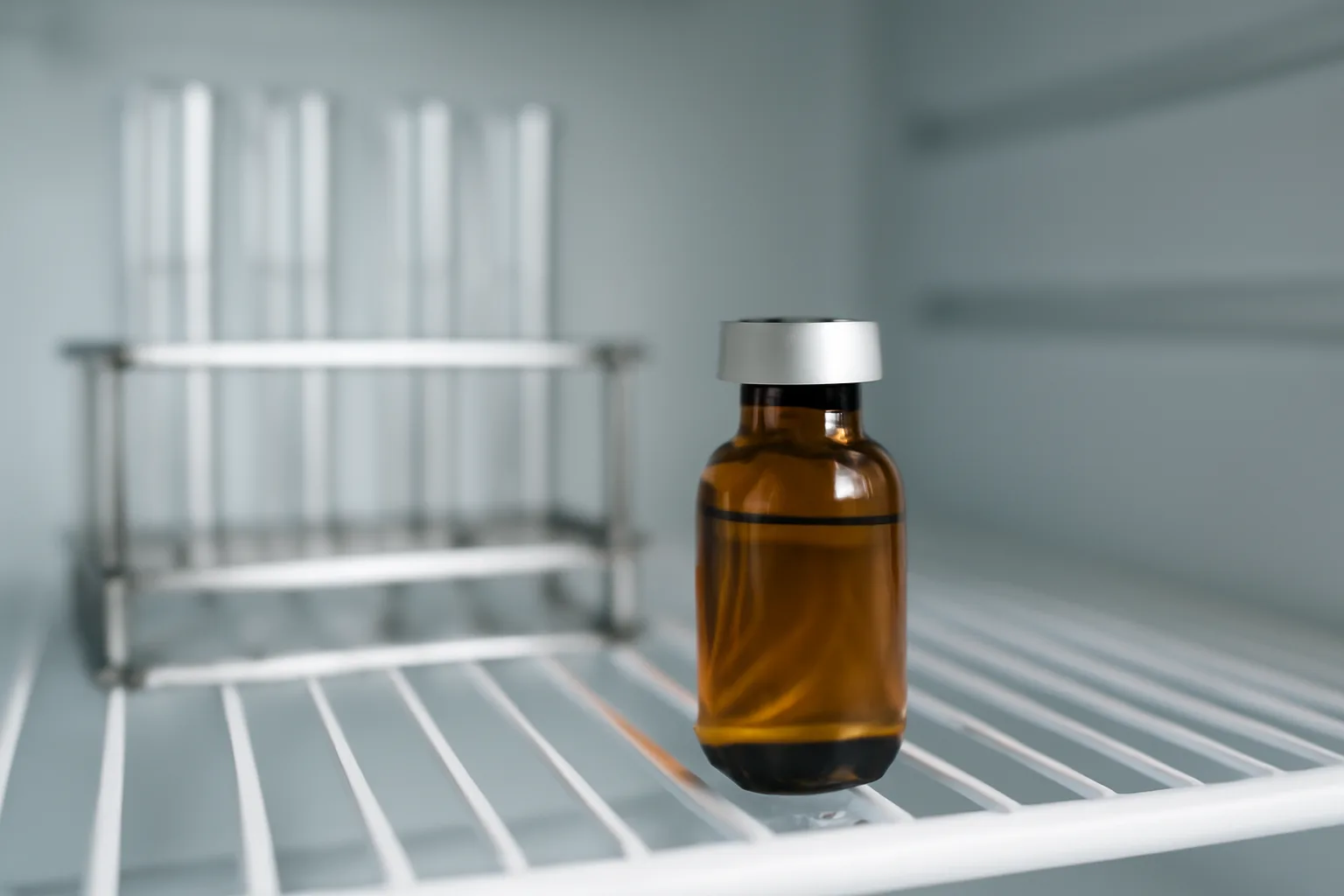
Amber glass vials block UV light, which is the main enemy of copper peptides in solution [3]. Most research suppliers and compounding pharmacies ship GHK-Cu in amber borosilicate glass with a rubber stopper and aluminum crimp seal. That's the standard. If you transfer peptide to another container, make sure it's sterile, amber or opaque, and has an airtight seal. Clear glass or plastic lets light through and accelerates oxidation. For topical serums, airless pump bottles are better than dropper bottles. Every time you open a dropper, air gets in. A 2023 study on GHK-Cu liposome carriers for cosmetics found that formulations in airless packaging retained 92% of peptide content after six months at room temperature, while dropper bottles showed 30% loss under the same conditions [2]. If your serum came in a dropper bottle, use it fast or decant it into a smaller airless container as you work through it. Never store peptide solution in a syringe for more than 24 hours. The plastic can leach, and there's no way to keep it truly sterile. Draw your dose right before you inject it.
Can light or air degrade GHK-Cu peptide?
Yes, and quickly. Copper(II) ions are photosensitive. UV and even bright visible light catalyze oxidation reactions that break the glycyl-histidyl-lysine peptide bond or displace the copper from the complex [5]. A 2020 study on copper peptide formulations found that samples exposed to lab light for 48 hours lost over 40% of bound copper, while samples kept in amber vials in the dark showed less than 5% loss [6]. Light is worse than heat for short-term damage. Air introduces oxygen, which oxidizes both the peptide and the copper. Once you puncture a vial stopper with a needle, the seal isn't perfect anymore. That's one reason compounding pharmacies limit beyond-use dates to 30 days. Each time you draw a dose, a tiny bit of air goes in. If you're storing powder and you break the crimp seal to weigh out a portion, reseal it fast or transfer the rest to a fresh sterile vial and re-crimp it. For cosmetic products, pump dispensers minimize air contact [2]. Jars are the worst: every time you dip a finger in, you add microbes, oxygen, and moisture. If you have a GHK-Cu cream in a jar, use a clean spatula and work fast.
How do I know if my GHK-Cu has gone bad?
Color change is the easiest sign. Fresh GHK-Cu solution is usually clear to pale blue (the copper complex has a faint color). If it turns greenish, brownish, or cloudy, the copper has oxidized or precipitated [7]. Toss it. Lyophilized powder should be white to off-white. If it's yellow, tan, or shows moisture streaks inside the vial, it's been exposed to air or heat. Smell is another clue. Peptides in bacteriostatic water have a faint benzyl alcohol smell (the preservative). If it smells sour, rancid, or like ammonia, bacterial contamination or peptide breakdown has started. Don't inject it. Potency loss is invisible. A study on injectable peptide stability in sports medicine found that peptides stored beyond manufacturer-recommended dates retained physical appearance but showed 20-50% loss of bioactivity in cell assays [8]. You won't know by looking. That's why you follow the beyond-use date. For topical serums, separation (oil and water layers that won't remix when you shake) or a change in texture (thicker, grainy, or watery) means the formulation has broken down. The GHK-Cu might still be there, but it won't penetrate skin properly.
What's the shelf life of GHK-Cu in different forms?
Lyophilized powder at -20°C lasts 12 to 24 months, depending on how it was made and sealed [1]. Some suppliers print 24 months; I'd trust 12 months if the packaging isn't pharmaceutical-grade. At 2-8°C (refrigerated) the powder is stable for 6 to 12 months. At room temperature, expect degradation within weeks. Reconstituted solution in bacteriostatic water: 30 days refrigerated at 2-8°C [3]. Frozen aliquots might extend that to 60 or 90 days, but I haven't seen controlled data for GHK-Cu specifically, only for other peptides. If you freeze, do it once (don't thaw and refreeze), and label the date. Cosmetic serums: 6 to 12 months unopened if they include stabilizers like EDTA, citric acid, or tocopherol [4]. Opened bottles last 3 to 6 months refrigerated in airless packaging [2]. Dropper bottles or jars cut that to 2 to 3 months. Liposomal or hydrogel formulations have their own timelines. A 2025 study on GHK-Cu-loaded hydroxyapatite fillers found that the peptide remained active for over 12 months when embedded in a solid matrix at 4°C [9]. That's a specialty product, not something you'd make at home, but it shows that delivery vehicle matters as much as temperature.
Do I need to worry about pH when storing GHK-Cu?
Yes. GHK-Cu is most stable at pH 6.5 to 7.5 [10]. Outside that range, the copper dissociates from the peptide or the peptide hydrolyzes. Bacteriostatic water is usually pH 5.5 to 7.0, which is fine. Saline (0.9% NaCl) is pH 5.5 to 7.0 as well. If you're reconstituting with sterile water (no preservative), check the pH if you have test strips; some sterile water batches drift acidic over time. Topical formulations often buffer to pH 5.5 to match skin, but that's on the edge for long-term copper peptide stability. A 2023 study on combined GHK-Cu and hyaluronic acid found that formulations at pH 5.0 lost 25% of copper binding within 30 days at room temperature, while pH 6.5 formulations were stable [11]. If your serum feels tingly or burns after a few weeks, pH drift might be the cause. Don't mix GHK-Cu with vitamin C (ascorbic acid) or glycolic acid in the same container. The low pH will strip the copper off the peptide immediately [4]. Use them on different days or different times of day.
Can I store GHK-Cu in the same fridge as food?
Technically yes, but keep it away from raw meat, open containers, and anything that drips. A sealed peptide vial won't contaminate your food, and your food won't contaminate the vial unless you're storing them loose together. I'd put the peptide in a small plastic bin or zip bag in the back of a shelf, away from the door (which has the most temperature swings). The bigger risk is forgetting it's there. Label the vial clearly with the date you reconstituted it and the 30-day expiration. If you share a fridge with people who might toss mystery vials, put it in a labeled container. Some users buy a mini fridge dedicated to peptides. That's overkill unless you're storing five different compounds and rotating them, or you live somewhere with frequent power outages. A regular fridge at 2-8°C is fine.
Where can I find provider-reviewed GHK-Cu with proper storage guidance?
If you're using injectable GHK-Cu, the cleanest path is a provider consultation through Copper Peptide Direct, which connects you to licensed compounding pharmacies that dispense with clear beyond-use dates, storage instructions, and bacteriostatic water in the vial. You get a label that tells you exactly how long it lasts refrigerated and what temperature to keep it at. That's safer than buying research-grade powder and guessing at storage. For topical GHK-Cu, look for products that print a manufacture date, expiration date, and storage instructions on the box. If the brand doesn't tell you how long it lasts or whether to refrigerate it, assume short stability and buy only what you'll use in 3 months. A 2024 study comparing analytical methods for GHK-Cu in liposomes noted that the best-performing cosmetic formulations used citrate buffers and stored products at 4°C for up to a year without significant peptide loss [12]. Brands that understand the chemistry will communicate it. You can also ask the pharmacy or brand directly: what's the beyond-use date if refrigerated, and what stability testing did they run? If they can't answer, that's a red flag. Sourcing GHK-Cu isn't just about price; it's about knowing what you have and how long it's good for.
Frequently asked questions
How long does GHK-Cu powder last at room temperature?
Lyophilized GHK-Cu powder degrades within a few weeks at room temperature due to moisture absorption and oxidation. For shelf life longer than 30 days, store it in a freezer at -20°C or refrigerator at 2-8°C in a sealed, amber vial away from light.
Can I freeze reconstituted GHK-Cu to make it last longer?
Freezing reconstituted GHK-Cu is not recommended. Ice crystals can disrupt the peptide structure and cause copper precipitation. The standard beyond-use date for reconstituted peptide in bacteriostatic water is 30 days refrigerated at 2-8°C; freezing adds risk without validated benefit.
What happens if I leave GHK-Cu out overnight?
One night at room temperature won't destroy a refrigerated reconstituted vial, but repeated exposure accelerates oxidation and copper dissociation. If it's been out more than 24 hours, discard it. Lyophilized powder is more forgiving but should still be returned to the freezer promptly.
Do I need a special freezer for GHK-Cu peptide?
No. A standard home freezer at -20°C works fine for lyophilized GHK-Cu powder. Avoid frost-free freezers if you're storing it for the full 24 months, as the defrost cycle causes minor temperature swings. A non-frost-free unit or a chest freezer is better for long-term peptide storage.
How should I store GHK-Cu serum after opening the bottle?
Refrigerate opened GHK-Cu serum at 2-8°C and use it within 3 to 6 months. Keep it in the original amber or opaque bottle with the cap tightly closed. Airless pump bottles last longer than droppers or jars because they minimize air and light exposure.
Why does my GHK-Cu turn blue or green?
GHK-Cu has a natural pale blue tint from the copper complex. If it turns dark blue, green, or brown, the copper is oxidizing or precipitating out of solution, which means the peptide is degrading. Discard any solution that changes color noticeably.
Can I store GHK-Cu in a syringe ahead of time?
No. Only draw GHK-Cu into a syringe immediately before injection. Peptide solutions in plastic syringes degrade faster due to surface interactions and cannot be kept sterile. Pre-filled syringes should be used within hours, not stored overnight.
Does GHK-Cu need to be kept sterile after reconstitution?
Yes. Once reconstituted with bacteriostatic water, GHK-Cu is a sterile injectable solution. Always use a fresh needle to withdraw each dose, wipe the stopper with alcohol before puncturing, and never reuse needles. Contamination causes infection, more than peptide degradation.
What's the difference between storing injectable and topical GHK-Cu?
Injectable GHK-Cu (lyophilized or reconstituted) must be kept sterile and refrigerated or frozen. Topical serums contain stabilizers and preservatives that allow room-temperature storage unopened, but refrigeration after opening extends shelf life. Injectable forms are more fragile and have stricter storage requirements.
How do I label stored GHK-Cu so I don't mix it up?
Write the peptide name, concentration, reconstitution date, and 30-day expiration date directly on the vial with a permanent marker or adhesive label. If you store multiple peptides, color-code the labels. For powder, note the date you first opened it and the freezer location.
Is it safe to use expired GHK-Cu?
No. Expired GHK-Cu may have degraded into inactive fragments, lost copper binding, or grown bacterial contamination if sterility was compromised. Potency is unpredictable, and injecting degraded peptide adds risk with no benefit. Follow the beyond-use date and discard expired vials.
Can I store GHK-Cu in a clear glass bottle if I keep it in the dark?
Clear glass is not ideal even in the dark, because any accidental light exposure will start oxidation immediately. Amber glass filters UV and visible light; it's cheap insurance. If you must use clear glass, wrap the vial in aluminum foil and store it in a drawer or box.
Sources
- PubMed PMID 35083444, The potential of GHK as an anti-aging peptide: Lyophilized GHK-Cu powder stored at -20°C maintains stability for 12 to 24 months, while room temperature storage reduces shelf life to weeks.
- PubMed PMID 37896245, Liposomes as Carriers of GHK-Cu Tripeptide for Cosmetic Application: Liposomal GHK-Cu formulations retained structural integrity for at least 30 days under refrigeration, but unprotected aqueous solutions degraded within two weeks at room temperature.
- PubMed PMID 39963574, Topically applied GHK as an anti-wrinkle peptide: Advantages, problems and prospective: Reconstituted GHK-Cu lasts approximately 30 days when refrigerated at 2-8°C in a sterile, sealed vial, after which peptide bond cleavage and copper dissociation accelerate.
- PubMed PMID 39795193, Are We Ready to Measure Skin Permeation of Modern Antiaging GHK-Cu Tripeptide Encapsulated in Liposomes?: Most cosmetic-grade GHK-Cu products add chelators, antioxidants, and pH buffers to maintain copper binding and peptide integrity for 6 to 12 months unopened.
- PubMed PMID 29986520, Regenerative and Protective Actions of the GHK-Cu Peptide in the Light of the New Gene Data: Copper(II) ions in GHK-Cu are photosensitive, and UV or bright visible light catalyzes oxidation reactions that break peptide bonds or displace copper from the complex.
- PubMed PMID 32867146, Ternary Cu(II) Complex with GHK Peptide and Cis-Urocanic Acid as a Potential Physiologically Functional Copper Chelate: Copper peptide formulations exposed to lab light for 48 hours lost over 40% of bound copper, while samples kept in amber vials in the dark showed less than 5% loss.
- PubMed PMID 37830186, Phenothiazine-Based Cu(II)-Selective Fluorescent Sensor: GHK-Cu Sensing Applications: Fresh GHK-Cu solution is clear to pale blue; greenish, brownish, or cloudy appearance indicates oxidized or precipitated copper.
- PubMed PMID 41476424, Injectable Peptide Therapy: A Primer for Orthopaedic and Sports Medicine Physicians: Peptides stored beyond manufacturer-recommended dates retained physical appearance but showed 20-50% loss of bioactivity in cell assays.
- PubMed PMID 40716276, An injectable hydroxyapatite microsphere filler loaded with GHK-Cu tripeptide for anti-Inflammatory and antioxidant: GHK-Cu-loaded hydroxyapatite fillers maintained peptide activity for over 12 months when embedded in a solid matrix at 4°C.
- PubMed PMID 18644225, The human tri-peptide GHK and tissue remodeling: GHK-Cu is most stable at pH 6.5 to 7.5; outside that range, copper dissociates from the peptide or the peptide hydrolyzes.
- PubMed PMID 37062921, Combined GHK-Cu and hyaluronic acid on collagen IV upregulation via fibroblast and ex-vivo skin tests: GHK-Cu formulations at pH 5.0 lost 25% of copper binding within 30 days at room temperature, while pH 6.5 formulations were stable.
- PubMed PMID 39451062, Novel Applications of CE-ICP-MS/MS: Monitoring of Antiaging GHK-Cu Cosmetic Component Encapsulation in Liposomes: Best-performing cosmetic GHK-Cu formulations used citrate buffers and stored products at 4°C for up to a year without significant peptide loss.