Last updated 2026-07-25
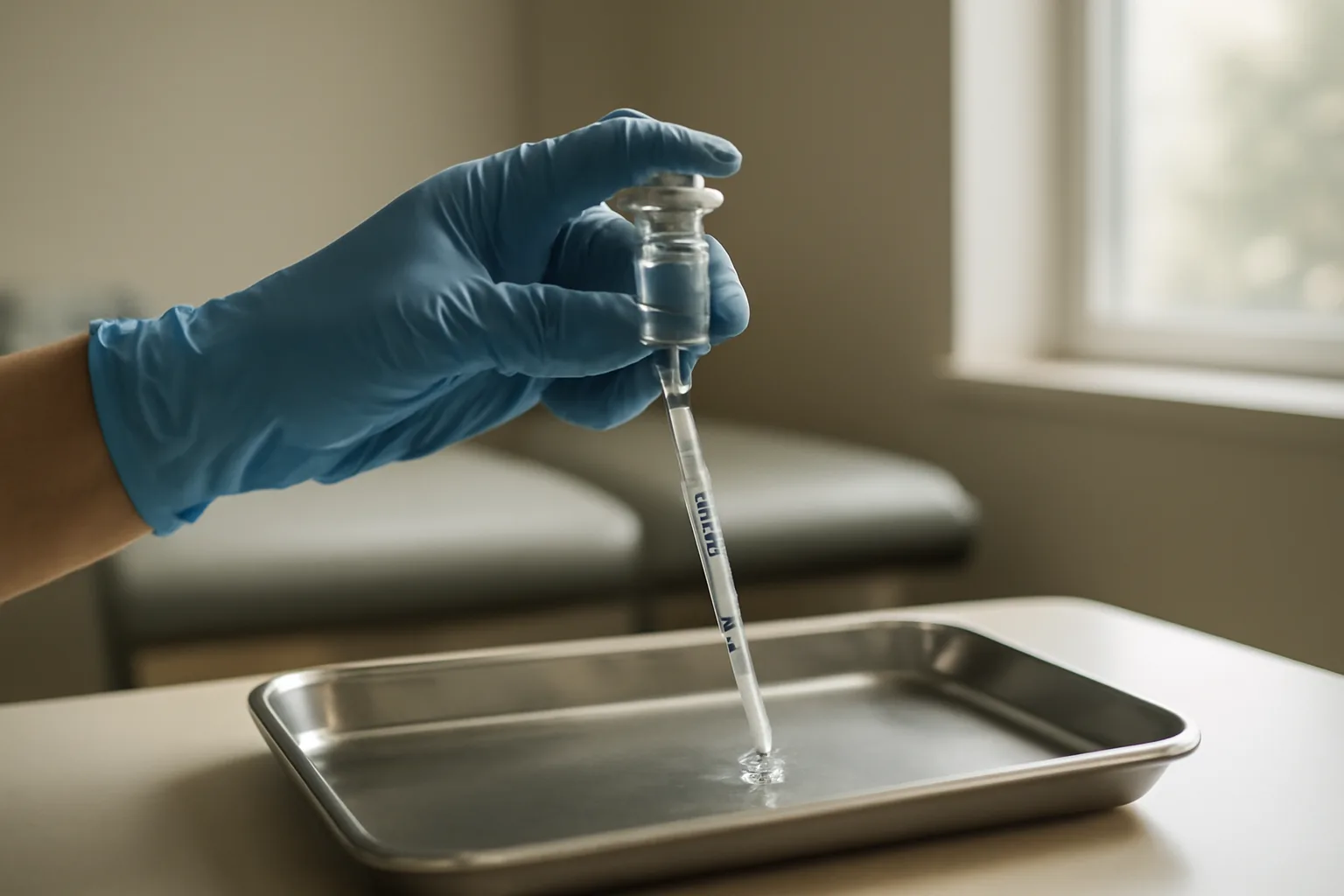
TL;DR
No clinical trial has mapped out approved subcutaneous injection sites for GHK-Cu in humans. Most site-specific data come from rat and mouse models (abdominal fat pads, joint spaces, lungs) or from topical dermatology work that doesn't transfer to injection at all. Anyone injecting GHK-Cu is working from animal pharmacology and general subcutaneous injection technique, not a site-specific human protocol.
Is there an actual established injection site for GHK-Cu?
No. There's no FDA-approved GHK-Cu drug product, so there's no package insert, no clinical dosing chart, and no verified site rotation schedule the way there is for, say, insulin or semaglutide. What exists is a wide animal literature (rats, mice) using intraperitoneal, intramuscular, or local joint injection, plus a much larger topical dermatology literature that answers a completely different question. That gap matters because people often assume "studied peptide" means "studied injection protocol." GHK-Cu genuinely is one of the more researched peptides out there, with work spanning wound healing, lung fibrosis, colitis, and orthopedics [1] [2]. But researched in what route, and in what species, changes what you can responsibly conclude for a human subcutaneous shot. A 2026 orthopedic review covering peptide therapeutics for musculoskeletal use, including copper peptide chemistry, notes the field is moving faster than the regulatory and safety framework around it, and explicitly flags gaps in dosing standardization across peptide classes [3]. That's a fair description of where GHK-Cu injection practice sits today: plausible biology, thin human-specific site data.
What does the animal research actually say about injection location?
The strongest site-specific injectable data come from a 2015 rat study of ACL reconstruction, where GHK-Cu(II) was delivered locally at the joint reconstruction site and produced a transient improvement in healing markers compared to controls, an effect that did not persist at later time points [4]. That's a local, surgical-field injection, not a generic subcutaneous fat injection, and it's in a rat knee, not a human deltoid or abdomen. A 2026 paper on Golgi-targeted copper delivery for fascia regeneration used a targeted delivery strategy aimed at boosting copper-dependent enzyme activity specifically at the fascia, again a tissue-targeted approach rather than a general subcutaneous site [5]. Separately, an injectable hydroxyapatite microsphere filler loaded with GHK-Cu was tested for anti-inflammatory and antioxidant effects, which is a dermal filler injection model, not a subcutaneous depot injection [6]. Lung and gut models (bleomycin-induced pulmonary fibrosis, LPS-induced acute lung injury, a colitis model) used systemic or intraperitoneal dosing in rodents to study organ-level effects, not localized subcutaneous administration relevant to a person choosing between abdomen, thigh, or upper arm [7] [8] [9]. None of this adds up to a validated human subcutaneous injection map.
Why doesn't the topical skin research tell us where to inject?
Because topical GHK-Cu has to get through the stratum corneum, and injectable GHK-Cu skips that barrier entirely, so the two routes are answering different pharmacology questions. Most of GHK-Cu's headline data (wrinkle reduction, collagen stimulation, wound closure) comes from topical or liposome-encapsulated formulations applied to skin surface, not from needle delivery [10] [11]. A 2025 review on GHK as a topical anti-wrinkle peptide is explicit that penetration is a real formulation problem: getting a tripeptide-copper complex through intact skin in meaningful concentration is not trivial, which is exactly why liposome encapsulation research exists [10] [11]. A 2025 study on measuring skin permeation of liposome-encapsulated GHK-Cu makes clear that even the delivery vehicle's efficiency is still being characterized with modern instrumentation like CE-ICP-MS [12] [13]. Inject GHK-Cu subcutaneously and you bypass all of that penetration chemistry. You're now asking a fat-and-connective-tissue absorption question, closer to how other subcutaneous peptides (growth hormone secretagogues, BPC-157 analogs people self-administer) get discussed, not closer to a serum applied to crow's feet. If a site claims topical wrinkle data as support for its injectable protocol, that's a red flag, not a bridge. For background on the topical side specifically, see what are copper peptides and best topical GHK-Cu.
What sites do people commonly use, and what's the actual reasoning?
People injecting GHK-Cu subcutaneously generally borrow the same rotation logic used for other subcutaneous peptides and insulin: abdomen (avoiding a two-inch ring around the navel), the outer thigh, the back of the upper arm, and sometimes the upper glute area. These sites are chosen because they have a reliable subcutaneous fat layer and are standard teaching sites in general injection technique, not because a GHK-Cu-specific trial validated them. Abdominal fat is the most commonly cited site in general subcutaneous injection guidance because it's easy to pinch, has consistent fat thickness in most adults, and allows self-rotation across quadrants. Thigh injection is the second most common self-administration site for the same reasons. None of the citations in this article support GHK-Cu specifically at these sites; this is general subcutaneous injection practice applied to a peptide that hasn't had its own site-comparison study published. A rotation table, for general orientation only:
Site comparison for general subcutaneous injection (not GHK-Cu-specific)
| Site | Typical fat depth | Common use case | GHK-Cu-specific data |
|---|---|---|---|
| Abdomen (avoiding navel area) | Moderate to high in most adults | Most common self-injection site for peptides/insulin | None; general practice only |
| Outer thigh | Moderate | Common alternate site, easy self-access | None; general practice only |
| Back of upper arm | Lower, harder to self-pinch | Often needs a second person | None; general practice only |
| Upper glute | Higher fat depth | Less commonly self-administered | None; general practice only |
| Local joint/fascia (research only) | N/A, tissue-targeted | Used in rat ACL and fascia-targeting studies | Yes, animal models only [4] [5] |
The last row is worth sitting with. The only site-specific human-relevant injectable data for GHK-Cu is local joint or fascia delivery in rodents, not generalized subcutaneous fat injection. Anyone doing abdominal or thigh subcutaneous injections is extrapolating from general peptide injection habits, not from a GHK-Cu trial.
Does injection site rotation matter for copper peptides specifically?
Rotation matters for the same reason it matters with any repeated subcutaneous injection: reducing lipohypertrophy, scar tissue, and localized irritation. There isn't published data showing GHK-Cu behaves differently from other peptides in terms of site reaction risk, but copper compounds are generally more chemically reactive than inert saline, so localized irritation at an injection site is a reasonable thing to watch for even without a dedicated study. A 2023 paper describing a Cu(II)-selective fluorescent sensor built around GHK-Cu chemistry is a reminder that this molecule's whole identity is built on strong copper-binding behavior [14]. That's useful for lab detection, but it also means a poorly sourced or improperly reconstituted injectable copper peptide carries more chemical unpredictability at the injection site than a simple isotonic peptide would. Rotating sites, watching for redness that doesn't resolve in a few days, and stopping if you see hardened nodules is basic self-injection hygiene here, same as with any subcutaneous peptide.
How does subcutaneous injection compare with topical use for skin and wound goals?
If the goal is skin appearance (fine lines, texture, mild collagen support), the evidence base sits almost entirely on the topical side, and injecting doesn't have data showing it does that job better. GHK-Cu's role in stimulating collagen IV and working synergistically with hyaluronic acid has been shown in fibroblast and ex-vivo skin models using topical-style exposure, not injection [15]. A 2017 mouse study did use GHK-Cu liposomes to accelerate scald wound healing, and that's genuinely a wound-healing use case, but the mechanism studied (cell proliferation, angiogenesis at the wound bed) was via topical liposome application to the wound surface, not a systemic subcutaneous shot [16]. Similarly, self-healing hydrogel work on infected wounds delivers the tripeptide-copper complex directly into the wound bed, a local dressing application, not a subcutaneous depot [17]. So if someone is choosing between a topical GHK-Cu serum and a subcutaneous injection for a skin-appearance goal, the honest answer is: the topical route has more relevant data pointed at that exact goal. Injectable GHK-Cu's stronger data points sit in organ and joint models (lung fibrosis, colitis, orthopedic tissue), not skin cosmesis. For readers focused on skin specifically, best copper peptides for face and best copper peptide for hair growth cover the topical evidence in more depth.
What about the orthopedic and sports medicine injection use cases people ask about?
There is real orthopedic interest in copper peptide chemistry for tendon, ligament, and fascia work, but it's early and mostly preclinical. A 2026 orthopedic review specifically covers therapeutic peptides including copper peptide mechanisms and states plainly that applications are still emerging with significant gaps around standardized protocols [3]. A companion 2026 primer aimed at orthopedic and sports medicine physicians frames injectable peptide therapy broadly, again emphasizing physician-level caution rather than home-injection protocols [18]. A 2026 review on peptide safety and efficacy for musculoskeletal injuries and athletic performance is even more direct about the unapproved-use problem, distinguishing peptides with real trial support from those circulating in performance and recovery circles without it [19]. GHK-Cu's orthopedic data (the rat ACL study, the fascia-targeting delivery paper) is preclinical and site-targeted at the joint or fascia itself, which is a different clinical scenario than a person injecting GHK-Cu subcutaneously into the abdomen hoping for joint or tendon benefit elsewhere in the body [4] [5].
Are there systemic or accumulation risks to worry about with copper peptide injection?
Yes, and this is where injectable use deserves more caution than a topical serum. Copper is an essential trace mineral, but it is not something the body handles as inert filler; excess systemic copper exposure is a genuine toxicological concern, and repeated subcutaneous dosing bypasses the skin barrier that limits how much of a topical product actually reaches circulation. None of the cited GHK-Cu papers report human accumulation data from chronic subcutaneous self-injection, because that protocol hasn't been through controlled human trials. The rodent studies used defined, monitored doses in a research setting with tissue and blood monitoring built into the study design [7] [8] [9]. A person self-injecting outside that kind of monitoring has no equivalent safety net checking their serum copper or liver function over time. This is also a sourcing and quality issue as much as a dosing issue. Because GHK-Cu is not an FDA-approved drug product, injectable versions typically reach people through 503A or 503B compounding pathways, and copper peptide's regulatory status there has shifted; providers and patients should check current bulk drug substance listings rather than assume any compounded copper peptide is automatically permitted [20] [21]. FDA maintains the current list of substances nominated and evaluated for 503A compounding use, and that list changes over time [22]. For general dosing context (not injection-site specific), see GHK-Cu dosage.
Where does provider-reviewed dispensing fit into this picture?
Because there's no approved injectable GHK-Cu product and no validated home-injection-site protocol, the safer version of "I want to try this" runs through a provider who can check current compounding legality, actually assess your skin and joint history, and monitor for reactions, rather than a self-sourced vial with no chain of custody. Copper Peptide Direct's provider-reviewed pathway exists for exactly this reason: it routes people to a fulfilling pharmacy partner operating within current compounding rules, rather than leaving injection-site decisions to guesswork from forum posts. That's not a claim that a provider has GHK-Cu-specific injection-site trial data to hand you, because nobody does yet. It is a claim that a provider can at least confirm the product's compounding status, check it against your own copper intake and any liver or Wilson's disease history, and give you a real reconstitution and rotation plan instead of an internet rumor.
So what's the actual bottom line on injection site?
There is no validated best subcutaneous injection site for GHK-Cu because there is no published human trial that tested one site against another. Abdomen and thigh are the sites people default to because they're standard for subcutaneous self-injection generally, not because GHK-Cu was proven to work best there. The peptide's stronger site-specific injectable data (joint, fascia) come from rat studies with local, surgical-adjacent delivery, a very different scenario from a home abdominal shot [4] [5]. If your goal is skin, the topical literature is deeper and more directly relevant than anything injectable [10] [10] [15]. If your goal is systemic or joint-adjacent, the animal data is interesting but far from a settled human protocol, and orthopedic reviewers are on record saying dosing standardization for this peptide class isn't there yet [3] [19]. Copper accumulation risk is real and understudied for chronic subcutaneous use in humans, which is reason enough to keep this under provider oversight rather than solo experimentation.
Frequently asked questions
What is the best injection site for GHK-Cu subcutaneous injections?
There isn't one established by human trial data. People default to abdomen or outer thigh because those are standard subcutaneous self-injection sites generally, not because a GHK-Cu-specific study compared sites. The only site-targeted GHK-Cu injectable data come from rat studies injecting directly at a joint or fascia site, not a generic subcutaneous fat depot.
Can I inject GHK-Cu in the same spot every time?
General subcutaneous injection practice recommends rotating sites to avoid lipohypertrophy and localized tissue irritation. No GHK-Cu-specific study addresses repeated same-site injection, so this recommendation is borrowed from general peptide and insulin injection guidance, not from copper peptide research directly.
Is injectable GHK-Cu the same product as topical GHK-Cu serum?
No. Topical GHK-Cu products are cosmetic formulations meant to sit on skin, often liposome-encapsulated to aid penetration [11][13]. Injectable GHK-Cu, where it exists, is a compounded preparation meant for subcutaneous administration and falls under different regulatory oversight (21 CFR 216.23, 216.24) than a cosmetic serum.
Does GHK-Cu injection help with wrinkles the way topical serums do?
There's no published trial testing subcutaneous GHK-Cu injection against topical application for wrinkle reduction. The wrinkle and collagen-stimulation evidence is built almost entirely on topical and ex-vivo skin models [12][17], so injecting for a cosmetic skin goal isn't supported by the same data people cite for serums.
What does the animal research say about GHK-Cu and joint or tendon healing?
A 2015 rat study injected GHK-Cu(II) locally at an ACL reconstruction site and found a transient improvement in healing markers that didn't hold up at later time points [4]. That's local joint delivery in rats, not a validated human subcutaneous protocol for tendon or ligament support.
Is there a risk of copper toxicity from injecting GHK-Cu subcutaneously?
Copper is not inert; excess systemic exposure is a genuine toxicological concern, and none of the published GHK-Cu studies report long-term human accumulation data from repeated self-injection. This is exactly why provider oversight, including bloodwork, matters more for injectable use than for a topical serum.
Is GHK-Cu FDA-approved as an injectable drug?
No. There is no FDA-approved GHK-Cu drug product listed in Drugs@FDA. Where injectable GHK-Cu is available, it typically comes through 503A or 503B pharmacy compounding pathways, governed by 21 U.S.C. 353a and the bulk drug substance lists at 21 CFR 216.23 and 216.24.
How is injectable GHK-Cu regulated compared to a cosmetic serum?
A cosmetic serum falls under general cosmetic labeling rules and doesn't need FDA drug approval as long as it makes only cosmetic claims (21 CFR 201.128 governs how "intended use" is determined). Injectable GHK-Cu, by contrast, is compounded under pharmacy law and depends on current bulk drug substance listings, which change over time.
What sites did GHK-Cu wound healing studies actually use?
Mouse studies of GHK-Cu liposomes for scald wound healing applied the liposomes topically to the wound bed, studying cell proliferation and angiogenesis at that surface [18]. A separate hydrogel study delivered the tripeptide-copper complex directly into an infected wound as a dressing, again local wound-bed application, not systemic subcutaneous injection [19].
Can GHK-Cu injections help with lung or gut inflammation like the animal studies suggest?
Rodent models show GHK-Cu reduced markers of lung fibrosis, acute lung injury, and colitis when given systemically or intraperitoneally in controlled research settings [7][8][9]. These are organ-level animal findings under monitored dosing, not evidence supporting a self-administered subcutaneous injection for the same purposes in humans.
Should I trust a provider or source that recommends a specific GHK-Cu injection site with confidence?
Be skeptical of absolute claims here, since no published human trial validates one subcutaneous site over another for GHK-Cu. A provider-reviewed source that's honest about the limits of the data, and checks your health history and current compounding legality, is more trustworthy than one offering a confident site map with no citation behind it.
What's the difference between subcutaneous and intramuscular injection for GHK-Cu?
Subcutaneous injection deposits the peptide into the fat layer beneath the skin, generally slower absorption; intramuscular goes into muscle tissue, generally faster absorption. Most published GHK-Cu animal studies used intraperitoneal or local tissue injection rather than either standard human subcutaneous or intramuscular routes, so neither route has GHK-Cu-specific human comparison data.
Sources
- International Journal of Molecular Sciences, 2018 (PMID 29986520): GHK-Cu has regenerative and protective gene-level actions described in recent molecular research.
- Aging Pathobiology and Therapeutics, 2020 (PMID 35083444): GHK is studied as a potential anti-aging peptide.
- Journal of the American Academy of Orthopaedic Surgeons Global Research & Reviews, 2026 (PMID 41490200): Orthopedic peptide therapeutics, including copper peptide chemistry, face gaps in standardized dosing protocols.
- Journal of Orthopaedic Research, 2015 (PMID 25731775): GHK-Cu(II) injected locally at an ACL reconstruction site in rats produced a transient healing improvement that did not persist.
- Journal of Controlled Release, 2026 (PMID 41371501): A Golgi-targeted copper delivery strategy was developed specifically to enhance copper-dependent protein activity for fascia regeneration.
- Colloids and Surfaces B: Biointerfaces, 2025 (PMID 40716276): An injectable hydroxyapatite microsphere filler loaded with GHK-Cu was tested for anti-inflammatory and antioxidant effects.
- Life Sciences, 2020 (PMID 31809714): GHK-Cu showed protective effects in bleomycin-induced pulmonary fibrosis via anti-oxidative and anti-inflammatory pathways.
- Oncotarget, 2016 (PMID 27517151): The GHK-Cu complex ameliorated lipopolysaccharide-induced acute lung injury in mice.
- Frontiers in Pharmacology, 2025 (PMID 40672369): GHK-Cu showed beneficial effects in an experimental model of colitis.
- BioImpacts, 2025 (PMID 39963574): Topically applied GHK is reviewed as an anti-wrinkle peptide with described advantages and formulation problems.
- Pharmaceutics, 2023 (PMID 37896245): Liposomes are used as carriers of GHK-Cu tripeptide specifically for cosmetic application.
- Molecules, 2025 (PMID 39795193): Measuring skin permeation of liposome-encapsulated GHK-Cu is an active and unresolved measurement challenge.
- Electrophoresis, 2024 (PMID 39451062): CE-ICP-MS/MS methods are used to monitor GHK-Cu cosmetic component encapsulation in liposomes.
- The Journal of Organic Chemistry, 2023 (PMID 37830186): GHK-Cu's strong copper-binding chemistry underlies its use in a Cu(II)-selective fluorescent sensor.
- Journal of Cosmetic Dermatology, 2023 (PMID 37062921): GHK-Cu combined with hyaluronic acid upregulated collagen IV in fibroblast and ex-vivo skin tests.
- Wound Repair and Regeneration, 2017 (PMID 28370978): GHK-Cu liposomes applied to scald wounds in mice accelerated healing via cell proliferation and angiogenesis.
- Biomaterials Research, 2025 (PMID 39902373): A food-derived tripeptide-copper self-healing hydrogel was applied directly to infected wounds to promote healing.
- The American Journal of Sports Medicine, 2026 (PMID 41476424): Injectable peptide therapy is framed as an emerging area requiring physician-level caution in sports medicine.
- Sports Medicine (Auckland, N.Z.), 2026 (PMID 41966639): Many peptide therapies used for musculoskeletal injury and athletic performance remain unapproved with limited safety and efficacy data.
- 21 CFR 216.23, the 503A Bulks List: Bulk drug substances eligible for 503A pharmacy compounding are defined by a specific federal list.
- 21 CFR 216.24, the 503B Bulks List: Bulk drug substances eligible for 503B outsourcing facility compounding are defined by a separate federal list.
- FDA, bulk drug substances nominated for use in compounding (current list): FDA maintains a current, updated list of substances nominated and evaluated for use in compounding under section 503A.