Last updated 2026-07-24
TL;DR
There's no FDA-validated GHK-Cu dosage calculator because human dosing comes from cosmetic formulation studies and animal models, not clinical trials with fixed mg/kg targets. What you can calculate precisely is reconstitution: mg of peptide divided by mL of solvent gives you concentration, and from there you can figure out volume per dose. The dose itself is a separate, much softer question.
What does a GHK-Cu dosage calculator actually calculate?
A GHK-Cu dosage calculator, in practice, does one of two very different jobs, and people mix them up constantly. Job one is reconstitution math: you have a vial with a stated peptide mass (say 100mg), you add a known volume of bacteriostatic water or saline, and you want to know the resulting concentration in mg/mL. That part is arithmetic. Mass divided by volume. No biology involved. Job two is dose selection: how many mg or mcg per kilogram of body weight, per day or per week, should a person actually use. This is where things get genuinely uncertain, because GHK-Cu has never gone through the kind of large, dose-ranging human clinical trial program that would let anyone publish a validated mg/kg table the way you'd see for an approved drug. Most of the quantitative work on GHK-Cu comes from cell culture, animal models, and topical cosmetic formulation studies [1][2]. A calculator can do job one with total confidence. Job two, it can only estimate, and any tool that claims otherwise is overselling its own math. This matters because a ghk-cu dosage page or app that spits out a precise-looking number ("2.3mg twice daily") is dressing up a guess in decimal points. The reconstitution number is real. The dose number is a judgment call, usually extrapolated from animal data or borrowed from unrelated peptide dosing conventions.
How do you calculate GHK-Cu reconstitution (the actual formula)
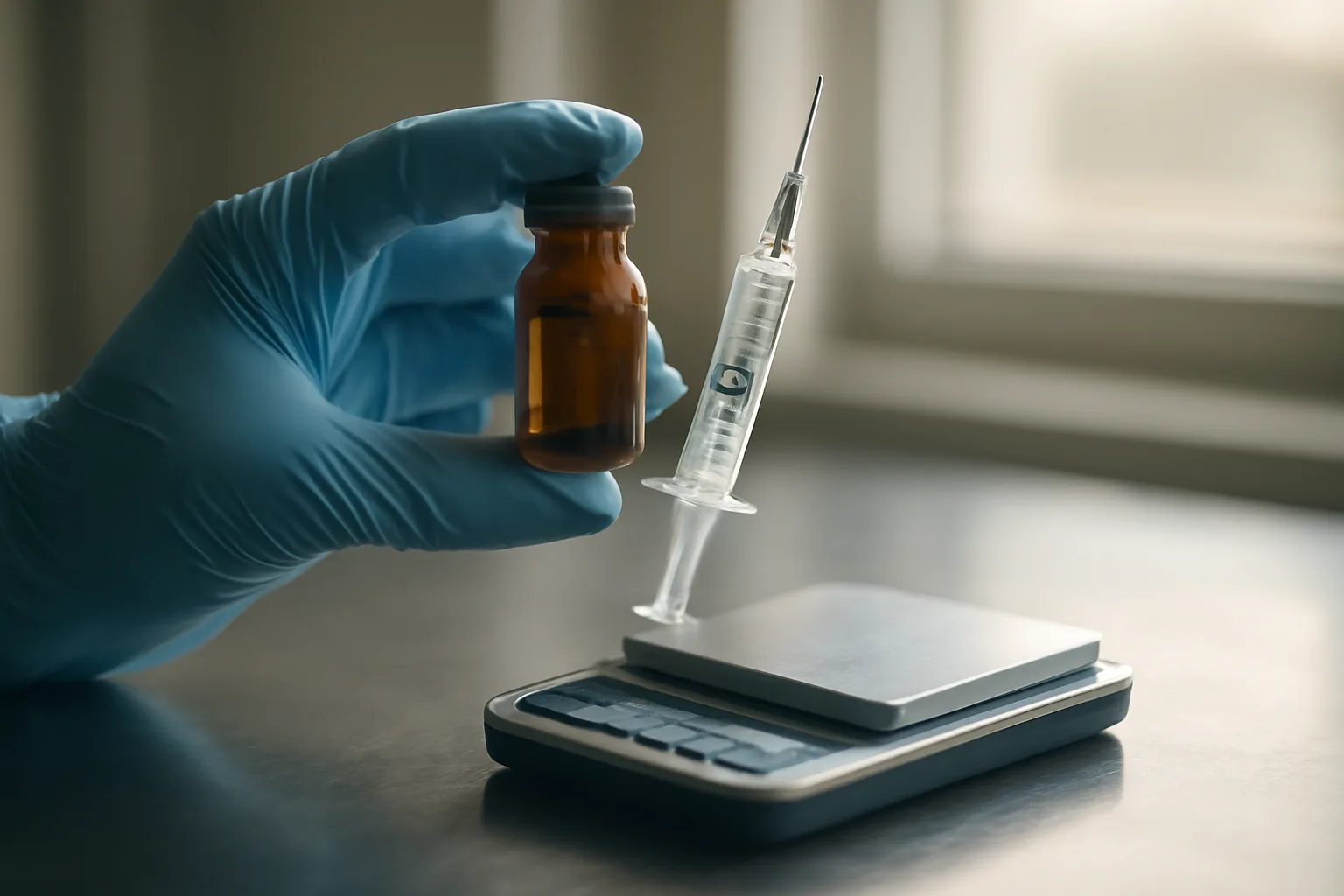
The reconstitution formula is simple and works for any lyophilized peptide, more than GHK-Cu: concentration (mg/mL) = total peptide mass (mg) divided by volume of solvent added (mL). Say you have a 100mg vial and you add 5mL of bacteriostatic water. That gives you 20mg/mL. Add 10mL instead, and you get 10mg/mL. More solvent means a more dilute solution, which means more volume per mg, which matters if you're using an insulin syringe marked in units or mL and want to avoid drawing up an awkwardly tiny volume. A GHK-Cu 100mg dosage calculator is just this formula wrapped in a form field. Enter 100 (mg), enter your solvent volume, get mg/mL out. From there, if you know how many mg you want per dose, you divide again: mg per dose divided by mg/mL concentration gives you the mL to draw up. If your syringe is in units (100-unit insulin syringe = 1mL), multiply the mL figure by 100 to get units. Here's a worked table for a 100mg vial reconstituted at a few common volumes:
| Solvent added | Concentration | Volume for a 1mg dose | Volume for a 2mg dose |
|---|---|---|---|
| 2mL | 50mg/mL | 0.02mL (2 units) | 0.04mL (4 units) |
| 5mL | 20mg/mL | 0.05mL (5 units) | 0.10mL (10 units) |
| 10mL | 10mg/mL | 0.10mL (10 units) | 0.20mL (20 units) |
This is the entirely mechanical half of a GHK-Cu peptide reconstitution calculator. It's correct regardless of what the dose target should be. The uncertainty lives entirely in that last question: what should the mg-per-dose number be in the first place.
Is there a validated human dose for GHK-Cu?
No. There is no FDA-approved dosing schedule for GHK-Cu, because there is no FDA-approved GHK-Cu drug product at all. You can check the Drugs@FDA database yourself and you won't find it [Drugs@FDA]. What exists instead is a large body of preclinical and cosmetic-formulation research: cell studies, rodent models, and topical penetration work, plus a couple of recent orthopedic-peptide review articles that treat GHK-Cu as one compound among several unapproved injectable peptides circulating in sports medicine and musculoskeletal practice [3][4][5]. Those orthopedic reviews are notable specifically because they exist to warn about this gap. A 2026 review in the Journal of the American Academy of Orthopaedic Surgeons Global Research & Reviews covers therapeutic peptides in orthopedic applications and frames dosing, safety, and regulatory status as open challenges rather than settled protocol [3]. A companion piece in The American Journal of Sports Medicine, aimed at orthopedic and sports medicine physicians, functions as a primer precisely because clinicians don't have standardized injectable peptide dosing to reach for [4]. And a 2026 Sports Medicine review on approved versus unapproved peptide therapies for musculoskeletal injury and athletic performance treats GHK-Cu-type compounds within the unapproved category, discussing safety and efficacy questions rather than citing a fixed dose [5]. The animal literature gives you numbers, but they're not human numbers. Rat and mouse studies on GHK-Cu use mg/kg dosing scaled to rodent body weight and rodent metabolism, which does not translate directly to humans by simple weight ratio. A rat ACL reconstruction study, for instance, found that a GHK-Cu(II) complex "transiently improved healing outcome" in the reconstructed tendon graft, using a rodent-specific dosing protocol that was never validated in people [6]. A GHK-Cu-liposome study in scald-wounded mice showed the compound accelerated wound healing by promoting cell proliferation and angiogenesis, again at a rodent dose [7]. These are real, useful data points for understanding mechanism. They are not a basis for calculating your dose.
How does topical GHK-Cu dosing differ from injectable dosing?
Topical and injectable GHK-Cu are different products with different oversight, different absorption, and almost entirely separate evidence bases. Conflating them is probably the single most common mistake people make when they go looking for a "GHK-Cu dosage." Most of the deep, decades-spanning GHK-Cu literature is topical and cosmetic. Studies look at collagen stimulation, anti-wrinkle effects, and skin penetration using serums, creams, or liposomal carriers applied to skin or tested on ex-vivo skin samples [8][9]. A 2025 BioImpacts review specifically examines GHK-Cu as a topical anti-wrinkle peptide, laying out the "advantages, problems and prospective" of applying it to skin, which by definition means it's discussing percutaneous absorption, not systemic dosing [8]. Liposomal encapsulation research, including a 2023 Pharmaceutics study and a 2025 Molecules paper asking whether we can even measure skin permeation of liposome-encapsulated GHK-Cu accurately, exists precisely because getting a tripeptide-copper complex through the stratum corneum in meaningful amounts is a real formulation problem [9][10]. A 2024 Electrophoresis paper used capillary electrophoresis-ICP-MS/MS specifically to monitor how much GHK-Cu actually ends up encapsulated in liposomes for cosmetic use, underscoring that manufacturers themselves need specialized analytical chemistry to verify their own products' content [11]. Injectable GHK-Cu is a completely different exposure route with a much thinner human evidence base. Injection bypasses the skin barrier entirely, so whatever dose-limiting absorption problem the liposome researchers are chasing simply doesn't apply, but that also means injectable exposure delivers copper and peptide systemically in a way topical use mostly doesn't. This is exactly why orthopedic and sports medicine literature treats injectable peptides, GHK-Cu included, as a distinct and higher-scrutiny category [4][5]. If you're comparing routes, read ghk cu peptides injections alongside the topical literature rather than assuming a cosmetic dose and an injectable dose are interchangeable by volume.
How do you calculate a GHK-Cu dose by body weight (mg/kg)
You can do the arithmetic, but you should know you're extrapolating past the actual evidence when you do it. A mg/kg calculation works like this: take a target dose expressed per kilogram (from an animal study, say), multiply by your body weight in kg, and you get a total mg figure. For example, if a rodent study used 2mg/kg in mice, a 70kg human is not simply 70kg x 2mg/kg = 140mg. Cross-species dose scaling doesn't work by simple linear multiplication because of differences in metabolic rate, body surface area, and clearance between species. Pharmacology conventions (like the FDA's own guidance on estimating a maximum safe starting dose in adult healthy volunteers) use body-surface-area conversion factors, not raw weight ratios, precisely because naive mg/kg scaling from rodents to humans tends to produce doses that are wrong, usually too high. None of the GHK-Cu animal papers in this research base (the scald-wound mouse study [7], the bleomycin-induced pulmonary fibrosis rat study [12], the cigarette-smoke skeletal muscle dysfunction study [13], the acute lung injury mouse study [14], the C. elegans aging study [15]) were designed to produce a human dosing table. They were designed to test mechanism: does GHK-Cu reduce fibrosis markers, does it rescue mitochondrial function, does it modulate a specific signaling pathway. A GHK-Cu dosage calculator that asks for your body weight and returns a confident mg number is applying a formula to data that was never meant to support that formula. That's the honest caveat, and any tool worth trusting should say so upfront rather than hiding it in fine print.
Does a GHK-Cu dosage calculator differ for women (GHK-Cu dosage calculator female)
There's no published sex-specific human dosing data for GHK-Cu, so a calculator that offers a distinct "female" mode is making an assumption, not citing a study. What probably drives the search for a "GHK-Cu dosage calculator female" is body weight. Since most weight-based dosing logic (however soft the underlying evidence) scales with kg, and average female body weight tends to be lower than average male body weight, a female-specific calculator is usually just running the same mg/kg formula against a lower typical weight input, not applying a biologically distinct dosing rule. If a calculator claims women need a different percentage adjustment beyond straightforward weight scaling, ask for the citation. None of the papers in the current GHK-Cu literature, topical or injectable, orthopedic or dermatologic, report a sex-differentiated human dosing protocol. The honest answer: use your actual body weight in whatever formula you're working from, understand that the formula itself is an extrapolation regardless of sex, and don't expect a meaningfully different number just because a calculator has a pink button instead of a blue one.
How much copper does a typical GHK-Cu dose actually deliver, and is that a problem?
Copper is not a benign filler ingredient just because it's bound to a peptide, and this is the part dosage calculators tend to gloss over entirely. GHK-Cu is, chemically, a copper(II) complex: the tripeptide glycyl-l-histidyl-l-lysine binds a copper ion, and multiple analytical chemistry papers exist purely to detect and quantify that copper-peptide binding, including fluorescent sensors and nanochannel-based detection methods built specifically around GHK-Cu's copper affinity [16][17]. That's not incidental trivia. It tells you copper is a defined, measurable, and biologically active part of every GHK-Cu dose, not a trace contaminant. Copper has a nutritional context most people never think about when they're calculating peptide doses: the human body needs it in small amounts (dietary reference intakes for adults sit in the low single-digit milligrams per day range), and copper accumulates in the liver, so chronic excess intake, from any source, is a real toxicological concern, not a peptide-specific one. None of the GHK-Cu papers in this research base establish a safe cumulative copper exposure ceiling for repeated injectable or high-dose topical use over months or years, and that gap should factor into anyone's dosing decision. A 2025 Frontiers in Pharmacology study on GHK-Cu in an experimental colitis model and a 2024 Redox Biology study on GHK-Cu in silicosis-related lung fibrosis both work with defined, controlled doses in animal models specifically because uncontrolled copper exposure is not something researchers treat casually [18][19]. If you're using a compounded or provider-dispensed GHK-Cu product regularly, this is worth raising directly with whoever is overseeing your use, and it's covered in more detail on ghk-cu side effects.
What's the difference between a 503A/503B compounded GHK-Cu vial and a cosmetic serum, for dosing purposes
These are regulated under completely different frameworks, and the dosing information (or lack of it) that comes with each reflects that. Compounded GHK-Cu, the kind dispensed through a 503A pharmacy (compounding for an individual patient prescription) or a 503B outsourcing facility (larger-batch compounding under different quality standards), falls under 21 U.S.C. 353a, the federal statute governing pharmacy compounding [20]. Whether a given bulk substance can legally be used in compounding at all depends on FDA's bulk drug substance lists: 21 CFR 216.23 for the 503A bulks list and 21 CFR 216.24 for the 503B bulks list [21][22]. FDA also maintains a running list of bulk drug substances nominated for compounding use that have not yet been formally added, which is worth checking directly rather than trusting a seller's claim about legal status [23]. A licensed pharmacy working under this framework can provide a specific concentration, a specific reconstitution instruction, and a specific dosing schedule tied to a provider's order, because that's what the compounding relationship legally requires. A cosmetic serum sold online has none of that structure. It's regulated as a cosmetic, not a compounded drug, its "intended use" under 21 CFR 201.128 is cosmetic (moisturizing, appearance-related), not therapeutic, and the manufacturer has no obligation to specify a peptide dose per application the way a compounding pharmacy does [24]. That's a big part of why liposomal-encapsulation researchers keep publishing papers just trying to verify how much GHK-Cu actually makes it into a given cosmetic formulation, let alone into skin [9][11]. If you're using a reconstitution calculator, know which category your product falls into. A calculator is only as good as the label accuracy behind the vial or bottle you're measuring.
What does the actual research say GHK-Cu does, at any dose
The mechanism research is genuinely deep for a peptide this size, and worth knowing regardless of what dose you land on. A foundational 2018 review in the International Journal of Molecular Sciences examined GHK-Cu's regenerative and protective actions using newer gene expression data, tying the peptide to broad gene-regulatory effects relevant to tissue remodeling [1]. A 2020 review in Aging Pathobiology and Therapeutics specifically frames GHK-Cu as a candidate anti-aging peptide, discussing its proposed mechanisms at the cellular level [2]. Older foundational work, a 2008 paper in the Journal of Biomaterials Science, Polymer Edition, established GHK's role in tissue remodeling as a starting point for much of the later formulation and mechanism research [25]. Beyond skin and aging, the compound shows up in a surprisingly wide range of disease models: a rat model of bleomycin-induced pulmonary fibrosis [12], a mouse model of lipopolysaccharide-induced acute lung injury [14], silicosis-related lung inflammation and fibrosis where GHK-Cu was shown to target a specific antioxidant enzyme, peroxiredoxin 6 [19], cigarette-smoke-induced skeletal muscle dysfunction where the effect was tied to a sirtuin 1-dependent pathway [13], and even C. elegans lifespan research showing effects on mitochondrial function and the DAF-16/SKN-1 longevity pathways [15]. There's also emerging orthopedic and materials-science work: a 2026 study on Golgi-targeted copper delivery for fascia regeneration [26], a 2025 study loading GHK-Cu onto injectable hydroxyapatite microspheres as a dermal filler with anti-inflammatory and antioxidant properties [27], and hyaluronan-conjugated GHK-Cu complexes showing combined antioxidant, osteogenic, and angiogenic effects [28]. None of this tells you your dose. All of it tells you why researchers keep returning to this molecule.
So what should you actually put into a GHK-Cu dosage calculator
Be honest about which number you're solving for, and don't let a slick interface disguise a guess as a fact. If you're solving for reconstitution concentration (mg/mL from a vial and a solvent volume), that math is solid, use it freely, and pair it with a mg/mL-to-units conversion if you're working with an insulin syringe. If you're solving for how many mg or mcg to actually use per dose, recognize that no calculator can give you a clinically validated number, because that number doesn't exist in the published human literature yet. The best a calculator can do here is show you what a given animal-study mg/kg figure would translate to at your body weight, with an explicit disclaimer that cross-species scaling is not equivalent to a human clinical dose. The more useful move is upstream of any calculator: work with a provider who can specify concentration, frequency, and duration for your specific product, and get that vial from a pharmacy operating under the 503A or 503B compounding framework rather than an unregulated online seller with no accountability for what's actually in the vial [20][21][22]. Copper Peptide Direct's editorial position on this is straightforward: we'll walk you through the arithmetic, but we point people toward the provider-reviewed, pharmacy-fulfilled route for actually obtaining and dosing GHK-Cu, rather than positioning any calculator as a substitute for that oversight. For the sourcing side of that decision, see buy ghkcu.
Frequently asked questions
Is there an official GHK-Cu dosage calculator endorsed by any medical body?
No. No medical society or FDA-approved labeling provides a validated GHK-Cu dosing calculator, because there's no FDA-approved GHK-Cu drug product to base one on. Reconstitution calculators (mg divided by mL) are just arithmetic and are reliable. Dose-per-kg calculators are extrapolations from animal or cosmetic research, not clinical guidance, and should be treated that way.
How do I calculate GHK-Cu reconstitution from a 100mg vial?
Divide the total peptide mass by the mL of solvent (usually bacteriostatic water) you add. A 100mg vial reconstituted with 5mL gives 20mg/mL; with 10mL gives 10mg/mL. To find the injection volume for a target dose, divide the desired mg by the mg/mL concentration, then convert to syringe units if needed (100 units = 1mL).
What is a typical GHK-Cu dose in mg or mcg?
There's no clinically validated human dose because GHK-Cu hasn't gone through FDA dose-ranging trials [Drugs@FDA database]. Numbers circulating online come from cosmetic formulation studies, animal models, or informal provider practice, not a standardized mg/kg protocol published in a peer-reviewed human trial.
Does the GHK-Cu dose differ for topical versus injectable use?
Yes, and they shouldn't be compared by volume. Most deep GHK-Cu research (anti-wrinkle effects, collagen stimulation, liposomal skin penetration) is topical [8][9]. Injectable GHK-Cu bypasses skin absorption entirely and is discussed in orthopedic and sports medicine literature as an unapproved peptide therapy requiring its own scrutiny [4][5], not as a stronger version of a topical dose.
Is there a different GHK-Cu dosage calculator for women?
Not based on any published sex-specific human study. A 'female' calculator mode typically just applies the same mg/kg style formula to a lower average body weight input. Use your actual weight in whatever formula you're working from; there's no evidence supporting a distinct percentage adjustment by sex.
How much copper is in a GHK-Cu injection, and can it accumulate?
GHK-Cu is a defined copper(II)-peptide complex, and copper is measurable and biologically active in every dose, confirmed by analytical chemistry work built specifically to detect it [16][17]. Copper accumulates in the liver with chronic excess intake from any source. No paper in the current GHK-Cu literature sets a safe cumulative exposure ceiling for repeated dosing over months or years.
Can I use an animal study's mg/kg dose and just scale it to my body weight?
Not reliably. Simple linear mg/kg scaling from rodents to humans tends to overestimate the human-equivalent dose, because species differ in metabolic rate and clearance, more than body mass. Animal studies on GHK-Cu (mouse wound healing, rat pulmonary fibrosis) were designed to test mechanism, not to produce a human dosing table [7][12].
What's the difference between a compounded GHK-Cu vial and a cosmetic GHK-Cu serum?
A compounded vial from a 503A or 503B pharmacy falls under federal compounding law (21 U.S.C. 353a) and FDA bulk drug substance lists [20][21][22], with a provider-specified dose. A cosmetic serum is regulated as a cosmetic under an 'intended use' framework (21 CFR 201.128) [24] with no obligation to specify a therapeutic peptide dose per application.
Do liposomal GHK-Cu products deliver a more predictable dose?
Liposomal encapsulation is meant to improve skin penetration, but researchers still struggle to verify exactly how much GHK-Cu makes it through skin even with encapsulation, per a 2025 Molecules study questioning whether current methods can measure this reliably [10]. Manufacturers use specialized techniques like CE-ICP-MS/MS just to confirm encapsulation content [11]. Precision here is a formulation science problem, not a solved one.
How do I convert mg/mL concentration into syringe units for GHK-Cu?
An insulin syringe marked in units assumes 100 units equals 1mL. Once you know your concentration in mg/mL, divide your target dose (mg) by the concentration to get mL, then multiply by 100 to get units. For example, 1mg divided by 20mg/mL equals 0.05mL, which is 5 units on a 100-unit syringe.
Is GHK-Cu FDA-approved for any use, topical or injectable?
No. There's no GHK-Cu product listed in the FDA's Drugs@FDA database of approved drugs. Cosmetic GHK-Cu products are sold under cosmetic regulations, not drug approval, and injectable GHK-Cu is discussed in recent sports medicine and orthopedic literature specifically as an unapproved peptide therapy [4][5].
Where does GHK-Cu dosing information for orthopedic or injury-related use come from?
Mostly from review articles surveying unapproved peptide use in sports medicine and orthopedics, not standardized clinical protocols. A 2026 JAAOS Global Research & Reviews article and a 2026 American Journal of Sports Medicine primer both cover GHK-Cu-type peptides as part of a broader, still-evolving unapproved peptide landscape for clinicians [3][4].
Sources
- International Journal of Molecular Sciences, 2018 (PMID 29986520): GHK-Cu's regenerative and protective actions reviewed in light of newer gene expression data
- Aging Pathobiology and Therapeutics, 2020 (PMID 35083444): GHK reviewed as a candidate anti-aging peptide with proposed cellular mechanisms
- Journal of the American Academy of Orthopaedic Surgeons Global Research & Reviews, 2026 (PMID 41490200): Review of therapeutic peptides in orthopedics frames dosing and regulatory status as open challenges
- The American Journal of Sports Medicine, 2026 (PMID 41476424): Primer for orthopedic and sports medicine physicians on injectable peptide therapy, reflecting lack of standardized protocols
- Sports Medicine (Auckland, N.Z.), 2026 (PMID 41966639): Review of safety and efficacy of approved versus unapproved peptide therapies for musculoskeletal injury and athletic performance
- Journal of Orthopaedic Research, 2015 (PMID 25731775): GHK-Cu(II) complex transiently improved healing outcome in a rat model of ACL reconstruction using a rodent-specific dosing protocol
- Wound Repair and Regeneration, 2017 (PMID 28370978): GHK-Cu-liposomes accelerated scald wound healing in mice by promoting cell proliferation and angiogenesis
- BioImpacts, 2025 (PMID 39963574): Topically applied GHK reviewed as an anti-wrinkle peptide with advantages, problems and prospects discussed
- Pharmaceutics, 2023 (PMID 37896245): Liposomes studied as carriers of GHK-Cu tripeptide for cosmetic application
- Molecules, 2025 (PMID 39795193): Study questions whether current methods can reliably measure skin permeation of liposome-encapsulated GHK-Cu
- Electrophoresis, 2024 (PMID 39451062): CE-ICP-MS/MS used to monitor GHK-Cu encapsulation content in cosmetic liposome formulations
- Life Sciences, 2020 (PMID 31809714): GHK-Cu shown protective in bleomycin-induced pulmonary fibrosis via anti-oxidative and anti-inflammatory pathways in an animal model
- Journal of Cachexia, Sarcopenia and Muscle, 2023 (PMID 36905132): GHK-Cu rescued cigarette smoking-induced skeletal muscle dysfunction via a sirtuin 1-dependent pathway
- Oncotarget, 2016 (PMID 27517151): GHK-Cu complex ameliorated lipopolysaccharide-induced acute lung injury in mice
- Biogerontology, 2026 (PMID 42084774): GHK-Cu delayed aging in C. elegans via mitochondrial regulation and DAF-16/SKN-1 pathway activation
- The Journal of Organic Chemistry, 2023 (PMID 37830186): Phenothiazine-based fluorescent sensor developed specifically for Cu(II) detection in GHK-Cu sensing applications
- Analytical Chemistry, 2023 (PMID 37624577): GHK-modified nanochannels used for ultrasensitive, label-free detection of copper ions
- Frontiers in Pharmacology, 2025 (PMID 40672369): GHK-Cu tested at controlled doses in an experimental colitis model to explore beneficial effects and mechanisms
- Redox Biology, 2024 (PMID 38879894): GHK-Cu attenuated lung inflammation and fibrosis in silicosis by targeting peroxiredoxin 6
- 21 U.S.C. 353a, pharmacy compounding statute: Federal statute governing pharmacy compounding under section 503A
- 21 CFR 216.23, the 503A Bulks List: FDA regulation listing bulk drug substances permitted for use in 503A pharmacy compounding
- 21 CFR 216.24, the 503B Bulks List: FDA regulation listing bulk drug substances permitted for use in 503B outsourcing facility compounding
- FDA, bulk drug substances nominated for use in compounding: FDA maintains a current list of bulk drug substances nominated for compounding that have not been formally added to the permitted lists
- 21 CFR 201.128, meaning of intended uses: FDA regulation defining intended use, which distinguishes cosmetic labeling claims from therapeutic drug claims
- Journal of Biomaterials Science, Polymer Edition, 2008 (PMID 18644225): Foundational paper establishing the human tri-peptide GHK's role in tissue remodeling
- Journal of Controlled Release, 2026 (PMID 41371501): Golgi-targeted copper delivery strategy studied for enhancing copper-dependent protein activity in fascia regeneration
- Colloids and Surfaces B: Biointerfaces, 2025 (PMID 40716276): Injectable hydroxyapatite microsphere filler loaded with GHK-Cu studied for anti-inflammatory and antioxidant dermal filler use
- Bioconjugate Chemistry, 2025 (PMID 40123442): Copper complexes with GHK-hyaluronan conjugates showed antioxidant, osteogenic, and angiogenic synergistic effects